Tuesday, July 12, 2022

Is China studying UAP?

South China Morning Post article

Last year, on 4 June 2021, an article appeared in the "South China Morning Post" about Chinese government interest in UAP, written by Stephen Chen, in Bejing. As we have heard no more about official Chinese government interest in the topic, since then, I thought it was worth while reprinting the text of that 2021 article.

"China military uses AI to track rapidly increasing UFOs.

* To the People's Liberation Army they are 'unidentified air condition' and artificial intelligence is the best way to keep up with them

* Chinese researchers confirm that sighting reports from across the country are on the rise but aliens are unlikely to be responsible.

As the Pentagon prepares its report on UFOs, due later this month, Chinese military researchers have turned to artificial intelligence to track and analyse the increasing number of unknown objects in China's airspace.

To the People's Liberation Army, they are 'unidentified air condition' - a phrase which echoes the US miltary's "Unidentified Aerial Phenomena" but to the public they are better known as unidentified flying objects, or UFOs.

According to Wuhan-based researcher Chen Li from the Air Force Early Warning Academy, human  analytics have been overwhelmed in recent years by the rapidly mounting sighting reports from a wide range of military and civilian sources across the country.

"The frequent awareness of unidentified air condition in recent years brings severe challenges to air defence security of our country," said Chen in a 2019 report to a conference of senior information technology scientists in Bejing in 2019.

The PLA's task force dedicated to the unknown objects increasing relies on AI techniques to analyse its data, according to Chen's report which is in line with several other military studies published in domestic journals, most recently in August last year.

According to Chen, one advantage of AI is that it can "think outside the box" - checking crumbs of information scattered across many data sets created at different times and locations, and draw links unseen by human eyes to help determine whether sightings were caused by a hostile country, amateur aviation enthusiasts, nature or "other reason" he said.

The question about UFOs which most captures the imagination is whether there are alien spaceships. The US military recently confirmed the authenticity of some leaked video footage captured by Navy pilots, in which flying objects appear to move in a manner that cannot be explained by current technology or physical laws.

The Pentagon report - required by Congress on these sightings which is expected to be partially released to the public - could be the first time any military has openly discussed the topic.

UFOs are a sensitive issue for any defence force, not only because they could be related to intelligent lifeforms from space, but also, and perhaps more likely, they may be incursions by another country's military.

An intruder enemy drone or aircraft, eqipped with adanced interference technology, for example, could fool radar or other sensors by creating ghost images that jump around in an inexplicable manner on screen, such incidents are usually classified for defence reasons, or to avoid embarrassment.

China's only official confirmed UFO sighting, occurred over a military airbase in Cangzhou, Hebei Province, on October 19, 1998. According to a report in Hebei Daily official newspaper of the Province, which neighbours Bejing - two military jets were ordered to intercept a low-flying object that appeared suddenly above an airbase. The object looked like a "short stemmed mushroom," with two beams of light shooting down from its belly. When the jets approached the object climbed with "ghost-like" speed to an altitude of 20,000 metres before disappearing from radar and visual contact. 

According to Chen and his colleagues, the PLA has a three-tier reporting system to handle unknown aerial objects. The base-level, which includes military radar stations, air-force pilots, police station, weather station and Chinese Academy of Science is responsible for gathering as much raw data as possible.

The information is passed mid-tier to the PLA's regional military command which conducts preliminary analysis and transferring the data to a national database.

With the help of AI, PLA headquarters assigns a "threat index" to each object based on its behaviour, frequency of occurrences, aerodynamic design, radioactivity, possible make and materials, along with other information.

The AI can pull together other information which may help determine an object's purpose. For instance, if similar unknown objects have a tendency to appear during major political events or military -exercises, they are considered more likely to be a man-made device deployed by another country to gather intelligence.

Nature is responsible for a significant proportion of the suspicious activity detected by the military. Ionised particle can be produced by electricity in the atmosphere, creating apaprently inexplicable images on radar, or other electronic systems, for example.

Manual verification of these events usually takes time, but AI can quickly identify most natural causes by cross-checking various pieces of information - such as weather, satellite data, according to the military researchers.

A radar scientist based in Xi'an in the northeast province of Shanxi said, the increasing number of unknown objects in China's airspace was "more likely caused by humans than aliens."

Chinese authorities have gradually lessened control on flight activity in low altitudes over the past five years with drones have also become relatively cheap and popular, he said.

Meanwhile, increased US military activity in the South China Sea and other sensitive waters near China could also account for the increased appearance of objects that cannot be immediately explained, said the researcher, who asked not to be named because of the sensitivity of the topic.

Comments:

1. No actual statistics are given for the previous, and current number of sightings in a given period.

2. No links, or citations are given for the Chinese Journal articles mentioned in the article.

3. Although many international media reports reported on the newspaper article, I cannot find any independent sources to confirm various details given in the article.

4. I did locate one paper by Chen Li and others, titled "Research on the optimization strategy of phased array radar multi-area search performance," by Yiming Liu; Wen Sheng; Shihua Liu; Chen Li, at the 11-13 December 2019 IEEE International Conference on Signal, Information and Data processing. The conference location is given as Chongqing, China.

Update: 31 July 2022

The Liberation Times posted an excellent review of China and UN efforts. 

Friday, July 8, 2022

A 2022 Australian Department of Defence Briefing Paper on UAP

Background

On 14 April 2022 I wrote a blog post about the establishment of Australia's new Defence Space Command, and that the initial Commander was Air Vice-Marshal Catherine Roberts. This prompted Melbourne researcher Grant Lavac to submit the following Freedom of Information Act (FOIA) request to the Australian Department of Defence (DOD.)

Air Vice-Marshal Catherine Roberts


“I kindly request a copy of all emails, sent to/from | bcc/cc’d Defence Space Commander Air Vice-Marshal Catherine Roberts for the period 25 June 2021 to 15 April 2022 (inclusive), that contain any of the following keywords: Unidentified Aerial Phenomena; UAP; Unidentified Flying Object; UFO; Unidentified Flying Objects; UFOs;, Unauthorised Aircraft Movement; UAM; Unauthorised Aircraft Movements; UAMs; Unusual Aerial Sighting, Unidentified Phenomena.”

DOD response 

The DOD assigned the request as FOIA 459/21/22, and then responded on 7 June 2022, releasing 14 pages of documents. These were:


1. An email from [redacted] to Roberts, Catherine, AVM, cc'd [redacted]; dated Friday 11 February 2022, Subject Senate Estimates Briefs. Text "As discussed please find official Senate Estimates Briefs." It mentions there are two briefs.

Comments: At the 27 October 2021, Senate Estimates Committee hearings, Senator Peter Whish-Wilson addressed a number of questions regarding UAP to then Chief of Air Mel Hupfield. My blog article dated 28 October 2021 provided a transcript of these discussions.   Grant Lavac located two written DOD responses to follow-up questions from Senator Whish-Wilson. Copies may be read here and here. They were dated 1 February 2022 and 6 December 2021, respectively. Thus this email to Air Vice-Marshal Roberts attaching Senate Estimate Briefs should be seen as prepping Roberts for any further questions on UAP.

2. A page headed "Space Domain and Policy. CAF Brief. Questions on Notice. Estimates QoNs." There are two broad topics referenced, namely UAP at the 27 October 2021 Estimates Hearing; and Space Policy at a 1 June 2021 hearing. 

3. A document headed "Unidentified Aerial Phenomena. CAF Brief." There is no indication as to who prepared the briefing document.


The contents listed are - Notes; Key Messages; Strategic Narrative; Talking Points; How are UAP reported to Defence?; As an ally, have the United States offered to or asked to collaborate on UAP investigations? With the US calling UAP a potential threat to national security, should Australia be concerned too; Timeline of Significant Events/Decisions; Relevant Media Coverage; Relevant Media Enquires; Relevant Ministerial Comments; Questions on Notice; Estimates QoNs; Other QoNs; Freedom of Information; Contact and Clearance officers. 

Notes

Area is blank (not redacted). 

Key Messages

"* Defence does not have a policy governing the reporting or recording of Unidentified Aerial Phenomena (UAP) by either members of the public or Defence members

* The Royal Australian Air Force (RAAF) ceased the handling of reports of UAP in 1996 after determining there was no scientific or other compelling reason to continue to devote resources to the recording and investigation of UAP

* Defence safety of flight incidents, including those potentially posed by UAP are handled by the Defence Aviation Safety Authority (DASA), with civilian safety of flight incidents the purview of the Civil Aviation Safety Authority (CASA)."

Comments: Point 1 has been the consistent response from the DOD to all my enquiries, and those by the media, eg. the ABC. Point 2 is indeed the reason given by the RAAF for cessation of UAP investigations. All their Base UAP files were bundled up, and sent to the National Archives of Australia, where, today, they are available for public viewing. 

On point 3, I don't think I have ever seen a statement before, that potential UAP flight safety incidents could turn up in DASA records. As far back as 2017, Melbourne researcher Paul Dean referenced DASA's predecessor, in an article about UAP. In March 2022 Grant Lavac submitted an FOIA request, assigned number 443/21/22 by the DOD. He asked for all DASA reports, between 2017 and 31 March 2022, which referenced UAP or various other similar keywords. There was a "Nil responsive documents" answer, from the DOD, dated 2 May 2022. 

Strategic Narrative

"UAP are likely to be one of three things:

* natual or other benign phenomena

* anomalies with sensors, or

* (human-made) technologies

UAP could be other nations systems, either contemporary or advanced. Information regarding the collection and investigation of these systems is the remit of the Intelligence Community and is classified."


Comment: I don't understand the statement "natural or other benign phenomena." Yes, "natural" but what does "benign phenomena" mean in this context? 

Background

"On 25 June 2021, the United States Office of the Director of National Intelligence (ODNI) released a Preliminary Assessment: Unidentified Aerial Phenomena (the Report) to provide an intelligence assessment of the threat posed by UAP and the progress the US Department of Defense Unidentified Aerial Phenomena Task Force (UAPTF) has made in understanding this threat.

* The Report does not draw conclusions on what UAP are and most remain unexplained, mainly due to lack of data

* The Report finds no evidence that UAP are extra-terrestrial in origin

* The Report did reach the following conclusions:

** In a limited number of incidents, UAP reportedly appeared to exhibit unusual flight characteristics. These observations could be the result of sensor errors, spoofing or observer misperception and require additional rigorous analyses

** There are probably multiple types of UAP requiring different explanations based on the range of appearances and behaviours described in the available reporting

** UAP clearly pose a safety of flight issue and may pose a challenge to U.S. national security. UAP would also represent a national security challenge if they are foreign adversary collection platforms or provide evidence a potential adversary has developed either a breakthrough or disruptive technology

** On 23 November 2021, the US Director of National Intelligence directed the establishment of the Airborne Object Identification and Management Synchronisation Group to coordinate reporting across US Department of Defence and other US agencies with the gaol to minimise flight safety and national security concerns


* Defence has no plans to replicate a similar mechanism. DASA and CASA already serve this function across flight safety issues and apparatus exist for concerns regarding national security

* Historically the RAAF was responsible for handling UAP reports, however that ceased in 1996. If civilians wish to report UAP they should contact their local police authorities, or get in contact with civil UAP research organisations

* The Defence Instruction was cancelled in November 2000 and not replaced

* UAP may also be referred to as Unidentified Flying Objects (UFO) or Unusual Aerial Sightings (UAS). UAP is the contemporary term for such phenomena."

Comments: Finally, someone in the DOD, has had to do some research on the topic to provide this briefing paper to Air Vice-Marshal Roberts. It's a fair summary of the ODNI report and RAAF involvement. Naturally, there is no indepth review of the material, which the RAAF collected between 1951 and 1996; in which, areas of the DOD itself said there was enough evidence to require an indepth study, by some government agency, such as the then Department of Supply. 

There probably is no-one in the DOD who has reviewed their own UAP related files, which are now in the National Archives of Australia. This does raise an interesting question as to how does someone in DOD knows the RAAF interest ceased in 1996 and the Standing Instruction was cancelled in 2000, if all their files are in the NAA? It would appear that some new recording system, eg an electronic file has been created to store this knowledge. Another topic for an FOIA request?

Talking points

"How are UAP reported to Defence?

* Defence does not have a policy for reporting or recording UAP

* Historically, the RAAF was responsible for handling UAP reports on behalf of Defence, however that ceased in 1996 after determining there was no scientific or other compelling reason to continue to devote resource to the recording and investigation of UAP

* Defence safety of flight incidents, including those potentailly posed by UAP are handled by the Defence Aviation Safety Authority (DASA), with civilian safety of flight incidents the purview of the Civil Aviation Safety Authority (CASA).

As an ally, have the United States offered to or asked to collaborate on UAP investigations?

* No, the United States nor any other nation or ally have requested or offered to collaborate on UAP reporting or investigation

* Defence has no desire to seek collaboration on this issue."

Comment: This last section answers a question I had, as to whether or not, the US had approached Australia to seek information or offer collaboration on UAP investigations.

With the US calling UAP a potential threat to national security, should Australia be concerned too?

* UAP are likely to be one of three things, natural or other benign phenomena, anomalies with sensors or (human-made) technologies. Information on the human-made technologies is classified and the remit of the Intelligence Community

* Countering capabilities spanning the maritime, land, air, cyber and space domains that could threaten our national security is a core business of the Australian Defence Force (ADF), any threat to national security is a concern but also a priority for Defence."

Comment: Looking at the agencies which make up the Australian National Intelligence Community, the one most likely to be involved in any collection and analysis of "human-made technologies " per UAP; is The Defence Intelligence Organisation (DIO.) Its role is as the Department of Defence's all-source intelligence assessment agency on countries and foreign organisations, looking at military capabilities, weapon systems, and defence-related technologies. So, if, for example, some UAP are foreign adversary drones, then the DIO would be interested. It would therefore appear reasonable to suggest, that if any portion of the entire Department of Defence were to take an interest in UAP, the DIO would be it. I have mentioned before that I suspect that some analyst in the DIO has a watching brief on the UAP topic. 

"Are UAP a risk to flight safety?

* Flight safety is a high priority for ADF aviation. Any risks to flight safety are considered serious, but Defence is not aware of UAP being the cause of an aviation safety incident or featured prominently in a safety investigation."

Comment: On the last point re flight safety, I doubt that ADF aviation has read any of the available NARCAP data, or looked into incidents such as the near-miss between a passenger aircraft and an "unknown" object near Perth on 19 March 2014 as reported to the Australian Transport Safety Bureau? 

"Are these likely to be extra-terrestrial in origin?

* There is no evidence to suggest that UAP would be extra-terrestrial in origin."

Timeline of significant events/decisions

This lists three events:

* 25 June 2021 - Release of ODNI report

*13 November 2000 - DI(G) ADMIN 55-1 outlining ADF policy cancelled

* 27 August 1996 - DI(G) 55-1 amended.

Relevant Media Coverage:

This lists the following media reports. 10 Nov 2021 The Sun; 9 Nov 2021 GQ UK; 29 Oct 2021 The Australian; 28 Oct 2021 ABC News; 25 Oct 2021 Remo News.

Relevant media inquiries:

Nil.

Relevant Ministerial comments:

Nil.

Questions on notice:

Whish-Wilson 27 October 2021 Senate Estimates.

Other QoN:

Nil.

Freedom of Information:

Nil.

Contact and Clearance Offices:

Clearing Officer AVM Catherine Roberts.

Consultation:

Mr Colin McKenna, Assistant Secretary Strategic Capabilities Policy Development.

Brig. Warren Gould, Director General Systems and Integration - Army.

Mr Rod Smith, STaR Shot Leader - Resiliant  Multi Mission Space , Defence Science and Technology Group. 

Comment: A search of the daily summaries of the Australian Senate Budget Estimates 2022-2023, for the Senate Foreign Affairs, Defence and Trade Legislation Committee, for hearings held on 1, 6 and 7 April 2022, failed to locate any mention of UAP. A search of the Hansard transcripts for those three days also failed to locate any mention of, or questions about, UAP. It would therefore appear, that the DOD brief was not used, as apparently no parliamentary questions were asked about UAP. 

Rest of documents

4. The rest of the documents released, deal with the Space Policy brief.

In summary

The Australian DOD has no interest in UAP. There are existing processes for any concerns re air safety or adversarial technology. 


Acknowledgement:

I wish to thank Grant Lavac for sharing the details of his FOIA requests, and the DOD responses. These documents should shortly be uploaded to the Australian DOD FOIA Disclosure log page. For the moment they may be accessed via this Dropbox link. 

Wednesday, July 6, 2022

M J Banias interviews Robert Bush - a former BAASS employee

Background

In 2019, I put together an Excel spreadsheet which listed a number of employees of  Bigelow Aerospace Advanced Space Studies (BAASS) who won the contract for the Defence Intelligence Agency's  (DIA) Advanced Aerospace Weapon System Applications program (AAWSAP.)

https://www.linkedin.com/in/robert-bush-95818013/

One of these employees was named Robert Bush. In his LinkedIn profile, Bush stated that he had been employed by BAASS between June and October 2009 as an investigator/security officer. Despite my efforts to contact Bush and ask him what he did, when employed by BAASS; he never responded.

Fast forward to 2022

M J Banias - image courtesy Amazon Books


Educator, author and blogger, M J Banias, succeeded in obtaining an interview with Bush as part of Banias' Fringe Network: Alien State, series of podcasts this year (2022) available through Apple Podcasts. Episode four of the series is titled "The Real X-files" and was released on 20 June 2022.

How did Bush get the job?

Bush states that he saw a job advert on the Indeed job site. It was for an investigator for BAASS. Bush sent in his resume and was called in for an interview with BAASS' Colm Kelleher. During the interview Bush was asked various UAP related questions, such as, had he heard of MUFON? Bush says the job was about trying to explain what these anomalies are. As Bush had had a lifetime interest in the unusual he seemed an ideal candidate for the position.

What did the job entail?

* Office based - to go through 10-20 reports a day which came in through the MUFON system

* Field based - then for an interesting case, an on-site field investigation was conducted

* Daily briefings on cases were held

* He, and others, had classified briefings from guest speakers

* Bush said he saw the USN UAP videos before the rest of us

* There were programs on the computers he used for checking weather details; aircraft; satellites etc

* Sometimes he called witnesses directly, to obtain further information

* Promising cases went to Kelleher to look at

* There was one case, Crown Point, New Mexico, which happened at a pumping station. They had 100 foot long, 50 foot tall, by 6 foot round concrete pillars down on the ground. All of a sudden they were picked up and thrown a couple of hundred yards away. No weather phenomena could explain it. No other explanation found.

Procedure

Bush referenced another case, where he interviewed a man in Ventura County, California. It was like a wormhole opened up. The man was a former law enforcement officer. BAASS personnel, including Bush, surveilled the property. On the second night, fog rolled in and the temperature dropped. Various pieces of their equipment failed. Bush saw an orb the size of a basketball, which dropped out of a cloud. Bush looked up and saw three big heads with big eyes looking down. There was no "craft." Bush said he had hoped that action would be taken on a case like this. Bush had no idea what happened to the report on this case. (Note this July 2009 case, is described in detail in the 2021 book "Skinwalkers at the Pentagon" by Lacatski et al, Chapter 7 "Lagol, California Investigation."

Layoffs

Soon after this, BAASS downsized and a number of staff were layed off, including himself. In hindsight, Bush says the equipment they had, and used, wasn't "fancy" enough. Bush says he doesn't know what happened to the evidence he gathered.

Friday, June 24, 2022

Canada to seek information on drones and UAP from the USA

 "Five Eyes"

The "Five Eyes" is the name of a multi-state agreement to share information gained from signals intelligence. The "Five Eyes" countries are Australia, New Zealand, Canada, the United Kingdom and the United States of America. The alliance can be traced back to the era of World War 2. It started with sharing between the UK and USA in 1941; Canada joined in 1948; and Australia and New Zealand in 1956.

The United States FY2022 Defense Authorization Act contained a provision for the establishment of an office within the US Department of Defense, to study Unidentified Aerial Phenomena (UAP.) The Airborne Object Identification and Management Synchronization Group (AOIMSG) came into being for this purpose.

One of the mandates for the new office was:

"Coordination with allies and partners of the United States, as appropriate, to better understand the nature and extent of Unidentified Aerial Phenomena."

Canada

My recent blog post about Canada and UAP discussed a UAP briefing, provided to the then Canadian Minister of Defence, and the interest shown by Conservative Member of Parliament Larry Maguire, on the topic of UAP. I wondered if the AOIMSG  had been in contact with the Canadian Government when I read the following?

On 2 March 2022, National Resources Canada (NRC) appeared before a meeting of the House of Commons Standing Committee on National Resources on the Supplementary Estimates. MP Larry Maguire asked a question on incident reporting of drone and UAP, in or near Canadian nuclear facilities.

NRC responded on 14 March 2022 to the Standing Committee on Natural Resources. This response was signed off by the Director General, Directorate of Security and Safeguards. The response was that the Canadian Nuclear Safety Commission (CNSC,) Canada's independent nuclear regulator, had advised "...there has been no reported drone intrusion or attempted intrusion at Canadian high-security nuclear facilities."

Further correspondence

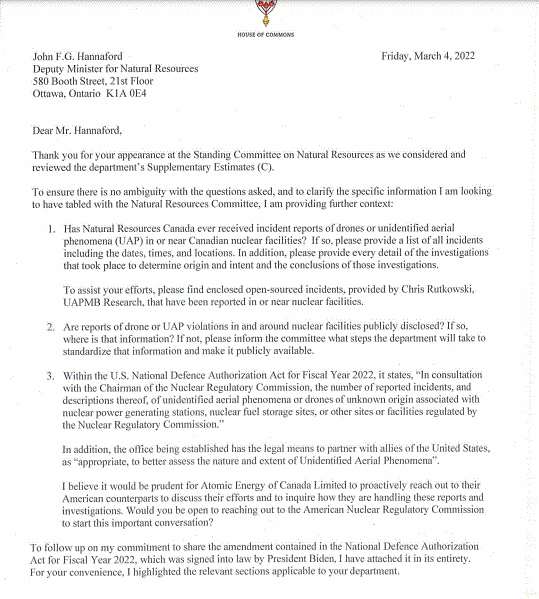
Two letters, dated 6 June 2022 are relevant to this matter. These are:

1. John Hannaford, Deputy Minister of Natural resources Canada, wrote to MP Maguire.

"I am writing in follow-up to my May 18, 2022, appearnce before the House of Commons Standing Committee on Natural Resources, where you raised security-related questions regarding the Government of Canada's position on drones and Unidentified Aerial Phenomena (UAPs) near North American nuclear facilities.

This is an important matter that my colleagues and I in the Natural Resources portfolio take very seriously. I would like to share with you some specific steps we have taken recently.

Beyond regular collaboration, in recent weeks the Department has liaised with the Canadian Nuclear Safety Commission (CNSC), Transport Canada and Public Safety Canada on this issue. Natural Resources Canada and the CNSC are working to support Transport Canada in developing a strategy to address emerging drone security issues.

To date, there have been no reported or attempted drone incursions at Canadian  high-security nuclear facilities. However, a request was made to fly a drone over a nuclear facility in early 2021, which the CSNC declined. 

Given the shared priority for nuclear safety and safety of nuclear facilities, and the growing interest in UAPs in both Canada and the United States, the CSNC is committed to raising the issue with its United States counterpart, and sharing any related information going forward.

We have reached out to counterparts in the United States Department of Energy regarding the Office of the Director of National Intelligence's Preliminary Report on UAPs to learn more about its perspective in order to help inform analysis and action in Canada.

Finally, Natural Resources Canada has a long-established Energy and Utilities Sector Network that shares threat information  between the Government of Cnada and energy sector critical infrastructure operators. We will continue to use this to gather intelligence on emerging threats, including drones and UAPs.

Kathleen Heppell-Masys, Director General of the CSNC, will respond in a follow-up letter to the six specific questions you asked during my May appearance.

Thank you for your interest in this important safery and security issue."

2. Dr Kathleen Heppell-Masys, Director General, Directorate of Security and Safeguards, Canada Nuclear Safety Commission to Larry Maguire.


https://www.ourcommons.ca/content/Committee/441/RNNR/WebDoc/WD11637088/11637088/LetterDeputyMinisterJohnF.G.Hannaford-e.pdf

"It was a pleasure to meet with you on May 17th, 2022. The information you provided in your March 4th letter helped us further understand the context and nature of your interests, concerns, and questions regarding drones and unidentified aerial phenomena (UAP) and I understand you raised a number of related issues the following day during a meeting of the House of Commons Standing Committee on Natural Resources (RNNR.)

Before I turn to addressing your questions, I would like to clarify that the CNSC is Canada's independent nuclear regulator. The CSNC is a quasi-judicial administrative tribunal that reports in Parliament through the Minister of Natural Resources, and  not to the Minister. As such, we will be able to to address your concerns and questions more expeditiously in the future if you contact us directly. As an open and transparent regulator, we welome the opportunity to work with Parliamentarians to ensure their information needs are met.

As we discuseed on May 17th, the CSNC's nuclear security requirements, including reporting requirements, encompass any nuclear security threats that involve an attempted or actual breach of security, or an atrempted or actual act of sabotage, including credible threats made against a nuclear power plant. This would include events involving drones and unidentified aerial phenomena (UAP.) The Nuclear Safety and Control Act, Nuclear Security Regulations, associated regulatory documents and licence conditions outline strong requirements on the part of licensees to ensure readiness to mitigate, deter, and respond to credible threats to regulated facilities.

The CNSC is taking steps to enquire with our licencees about any reported drones or UAP sightings and to confirm that nuclear safety was not put at risk from any related sightings. That includes a letter that I have sent to licensees for high-security nuclear sites.

We have also approached our Unites States Nuclear Regulatory Commission  (US NRC) colleagues regarding the nature of their nuclear security requirements for drones and UAPs and potentially evolving requirements. We will discuss their approach further as it evolves. For now, exisitng nuclear security requirements in both countries are well-aligned.

You had three particular questions for follow-up after our May 17th meeting:

1. Understanding the spectrum of CNSC- regulated facilties; 

2. The length of time Canadian nuclear facilities retain security-related data, including video  footage, and:

3. Confirming with CNSC licensees that no incidents with drones or UAPs have occurred at nuclear facilities since the March 2nd RNNR meeting.

On the first question. Canada has one of the most diverse nuclear sectors in the world. Regulated facilities include uranium mining, milling and refining; nuclear substances processing  and end users; fuel production; nuclear power and nuclear research reactors, and waste management.

On the second question, High Security Site Licensees are required to retain all relevant security related records regarding security events for the duration of their operating licence. Unless there is an identified incident, data that are not related to specific events may be disposed of by these licensees as per their specific security program and managment system program.

On the third question, the CNSC is not aware of any reported incidents of drones or UAPs near Canadian nuclear facilities. With a regulatory lens regarding nuclear security, we have taken steps to confirm with licensess that no such events have occurred.

You raised six related questions to Mr Hannaford, Deputy Minister of NRCan, at the May 18th meeting of RNNR. I would like to provide a response to five of the six questions. On the sixth question which pertains to the CNSC's receipt of your March 4th letter, I can confirm we have received  your letter and have since discussed these issues with NRCan.

1. A lack of standardized reporting requirements for licensees to  report on UAP or drones and no formal investigative guidelines to understand origin and/or intent; and

2. Your request to direct nuclear facility licensees to ask employees and security  officials to ensure all drone and UAP incidents are properly reported.

As discussed on May 17th, our regulatory framework is largely performance-based and not prescriptive in how licensees are to meet safety and security objectives and requirements. Licensees are required to report on credible threats. As mentioned above, I have sent a letter to licensees of high-security nuclear sites asking for relevant information. I will be pleased to update you with any related information received that I am able to share.

Licensees are required to prepare for and respond to any credible threats against their sites or facilities. In the caee of nuclear security events, an investigation would typically be led by the police service of jurisdiction and would be supported by the CNSC.

3. Whether NRCan would support the Chief Scientist Advisor (CSA,) were the Government to direct that she lead a whole-of-government approach to standardize the collection of reports and analysis for undentified drones and UAPs.

While this question was directed to NRCan, the CSNC as a technical and scientific organization would offer its full support to the CSA were she directed by government to undertake such an effort.

4. The willingness of the CNSC to begin a conversation with the US NRC on unidentified drones and UAPs.

As noted above, I have reached out to the US NRC and have concluded that our respective nuclear security reporting requirements are aligned. As noted above, we will discuss their approach further as it evolves.

5. Awareness by CNSC officials of UAP sigthings near Canadian nuclear facilities.

The CNSC has not received any reports of drones or UAP sightings near any nuclear facilities. Since our conversation, we have also confirmed that neither drones nor UAPs have caused breaches to nuclear security, or been involved in attempts or actual acts of sabotage  to the nuclear security of nuclear facilities.

I would be pleased to provide you with the results of our Request for Information  to licensees as mentioned earlier. Please feel free to contact the CNSC directly in the future on nuclear regulatory matters, and please do not hestiate to contact me if you have further questions."

AOIMSG cooperation?

So, this action by MP Maguire has led to Canada raising questions with their US counterparts in selected areas, i.e potential or actual drone and UAP intrusions in or near nuclear facilities.

There have been no indications that officials from the AOIMSG have been in contact with the Canadian government seeking cooperation  to "...better assess the nature and extent of UAP."

One question is raised in my mind. Has the US government approached the Australian government seeking co-operation to "...better assess the nature and extent of UAP"? An FOIA request will be submitted to the Australian Department of Defence to pose just this question. 

Thursday, June 23, 2022

The continuing search for Australian government documents concerning the 6 April 1966, Westall event

A report by Paul Dean, Shane Ryan, and Keith Basterfield 

Background

Many UAP researchers have spent time searching for references to the 6 April 1966 UAP event at Westall, Melbourne, Australia, in the files of the Australian government. The only reference we know about, was in a lengthy letter from a private individual to the Australian Department of Defence (DOD). In that letter, the individual posed a number of questions, and one was about Westall. The resultant response from the DOD did not answer many of the questions, and did not refer to Westall at all.

What researchers have more recently been looking for, is an official report which sets out what really happened that day. From numerous witnesses who were there at the time, we know that government officials told students and at least one teacher, not to talk about the event. We also know from members of the family, of a then senior officer of the former Australian government Department of Supply (DOS) that he wrote an official report on the incident. No one has ever found a copy of this report. In short, we can say that no-one has ever been able to locate any Australian government document that tells us exactly what occurred that day.

Department of Supply

An example of a DOS UAP file cover

Because of what we have learnt from our own research,  and what Australian investigative journalist Ross Coulthart wrote in his book "In Plain Sight," the recent focus of the search for references to Westall in Australian government files, has been on files generated by the DOS; in particular the Division which dealt with aircraft, and guided weapons. None of the known, and available, DOS files has been found to mention Westall. 

Image courtesy of Amazon Books

A three year search

Three years ago, we decided to look for previously unknown and unreleased DOS files, held by the National Archives of Australia (NAA.) We found a file series, MP1899/1  which seemed likely to have relevance to our search. However, none of the individual files from the series was listed on the NAA's database, called "RecordSearch."

A trip was then made, to the Melbourne office of the NAA, and there we located a hard copy "finding aid" listing the files in the series MP1899/1. This list of file control symbols and titles, was generated by the DOS when they transferred the files to the NAA. We looked through this list, and selected a small number of files which seemed the most relevant.

Time went by, during which there were a series of emails and telephone calls exchanged with the NAA. However, no files eventuated. After a couple of years of focussing on other research matters, we decided to return to the question of these DOS files. We determined that these files were still in existence and held at the NAA Burwood storage facility. During this process one of us got within 100 metres of the files, but were not allowed to look at them because their status was "not yet examined." Arrangements were then made, with the NAA Melbourne office, for the files to be "examined," and in late 2021 they were registed on RecordSearch. In January  and February 2022, one by one, their status changed to "open." This meant one could order a digital copy of the files (an expensive business) or view the files, in person, at the Melbourne NAA office.

The eight files


1. File series MP1899/1, control symbol G162/105/10. Barcode 1406735. Titled "Monthly report for Minister - 1966."

2. File series MP1899/1, control symbol G454/101/4 PART 2. Barcode 14406753. Titled "P.E.R.T. [Programme Evaluation Review Technique] Monthly reports from regional offices."

3. File series MP1899/1, control symbol G401/104/2. Barcode 14406739. Titled "Miscellaneous classified correspondence removed from project files."

4. File series MP1899/1, control symbol G454/101/4 PART 1. Barcode 14406733. Titled "Programme evaluation review techniques [PERT] Monthly reports from regional offices (1965-1969) A.G. W. & E.S. [Aircraft,  guided weapons and electronic supplies] comments."

5. File series MP1899/1, control symbol G433/106/10. Barcode 14406734. Titled "Australia/USA logistics arrangements estimates of expenditure requirements - A.G.W & E.S. Division aspects."

6. File series MP1899/1, control symbol G162/105/11 PART 1. Barcode 14406736. Titled "Department of Supply - Monthly report 1966."

7. File series MP1899/1, control symbol G162/105/11PART 2,. Barcode 14406737. Titled " Department of Supply - monthly report -1966."

8. File series MP1899/1, control symbol G177/107/3. Barcode 14406738. Titled "Guided weapons and electronic section - AGW&E Division (All states) - organisational matters."

The files are viewed

Credit: Shane Ryan


Due to a number of issues, such as COVID, family matters, and the days when the Melbourne NAA office is open; it wasn't until mid June 2022, that arrangements could be made for us to physically view the above files.

An examination of the above files was conducted on 22 June 2022 at the Melbourne NAA office. No material, relevant to the Westall incident was noted on any of the files. This further deepens the mystery of why no-one is able to locate any official documentation on this event.

Even though this latest search, has proved negative; we wished to document it, to indicate the thoroughness of our government files search for Westall related material.

Sunday, June 19, 2022

"Unauthorised aircraft movement" - the Australian Department of Defence, and UAP

Questions to the Australian Department of Defence

In June 2019 I asked the Australian Department of Defence, through its media section, a number of UAP related questsions, including the following:

"Has the Australian Department of Defence any current guidelines concerning the reporting by Department of Defence personnel, of Unidentified Aerial Phenomena? If so, may I obtain a copy?"

 Defence responded:

 "Defence does not have a protocol that covers recording or reporting of UFO sightings."

In June 2021, I submitted another series of question along the same lines, again through the media section, including:

"I am aware that the RAAF devoted resources in the time period 1951-1994 to the study of UAP. In the light of the above, is anyone in the Australian Department of Defence currently monitoring the subject of UAP?"

The response was:

"Defence does not have a protocol that covers recording or reporting of unidentified aerial phenomena/unidentified flying object sightings."

I then reasoned along the lines, if the DOD do not have a protocol for recording UAP/UFO what do they call an "unidentified object?" It seems to reason, that from time to time,the RAAF's sensors such as the Jindalee Operational Radar Network (JORN) would pick up an "unidentified object."

Paul Dean

Several years ago, Melbourne based researcher Paul Dean undertook a search for the term that  the DOD's RAAF used for an "unidentified object." In 2015 this search led him to the DOD releasing two documents under the FOIA.

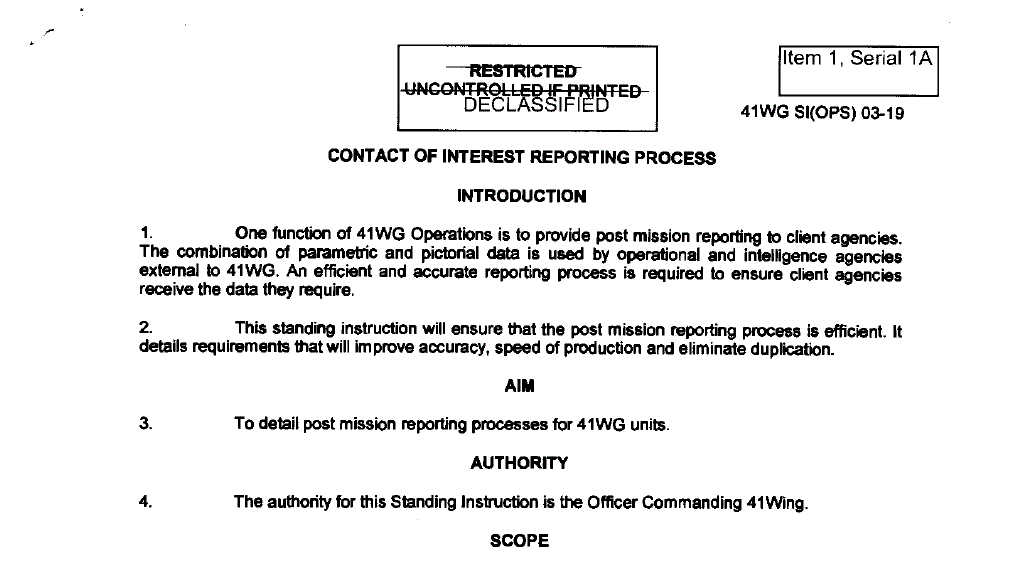
(1) 41 Wing Standing Instruction (Operations) 3-19 Contact of Interest Reporting procedures.


(2) RAAF 41 Wing Standing Instruction (Operations) 3-15 Unauthorised Aircraft Movement Reporting and Investigation Process.

Surveillance and Response group

Under the RAAF's organisational chart, part of of the RAAF, is the "Surveillance and Response Group." This includes the Headquarters Surveillance and Response Group (RAAF Williamtown.) Here we find HQ No. 41 Wing; HQ No. 42 Wing, HQ No. 44 Wing and HQ No. 92 Wing.

HQ No. 41 Wing has under it:

* No. 1 Remote Sensing Unit (1RSU) (Edinburgh)

* No. 3 Control & Reporting Unit (3CRU) (Williamtown)

* No. 114 Mobile Control & Reporting Unit (114MCRU) (Darwin)

* Surveillance & Control Training Unit (Williamtown.)

No. 1RSU

No.1 RSU's roles is radar surveillance and space situational awareness via a range of sensors, including:

* Jindalee Operational Radar Network (JORN)

* C-band radar

* The RAAF Space Surveillance telescope

* The Space Based Infrared System.

Contact of Interest

A "Contact of Interest" is defined in the first Standing Instruction above as:

"A Contact of Interest (COI) is defined as any track that matches or potentially matches current 41WG Tasking Intentions."

Unauthorised Aircraft Movement 

 In the second Standing Instruction above, there are two relevant definitions:

(10 UNK Unknown An evaluated track which has not been identified

(2) UAM Unauthorised Aircraft Movement An aircraft suspected of using Australian Airspace for illegal activity.

To be declared a UAM, a track must meet the following criteria:


"a. An IDENTIFIED track which deviates from published flight plans not due to weather, ATC or emergency, or

b. Identified as UNK by the active RCC after all local procedures to identify track have been exhausted; and

c. Be seen to, or suspected to have crossed the Australian FIR; and

d. Arrived or departed from an Australian airfield not controlled by Australian Customs."

Do any UAMs exhibit non-aircraft characteristics?

In order to answer the question, do any UAMs exhibit non-aircraft characteristics, i.e. could they be UAP? I submitted an FOIA request to the Department of Defence on 31 March 2022. My request was:

"I seek copies of documents dated between 25 June 2021 and 31 March 2022 relating to Unauthorised Aircraft Movements (UAM) which have been used to brief senior staff, including Chief of Air, Mel Hupfield where the UAM was either:

(a) labelled "unknown" after evaluation and/or

(b) behaved in a manner where its flight characteristics were outside of the parameters of conventional aircraft,/missiles/unmanned aerial systems. 

For the purpose of this request I will define the words "senior staff" to mean.

1. Deputy Chief of Air Force - Air Vice-Marshal Stephen Meredith.

2. Head of Air Force Capability - Air Vice-Marshal Robert Denney.

3. Head of Air Command - Air-Vice Marshal Joe Lervasi.

4. Head of the Defence Space Division /Force - Air Vice-Marshal Catherine Roberts.

5. Chief of Air, Mel Hupfield."

I received a respons email on 16 June 2022, although the Statement of Reasons PDF was actually signed off on 19 May 2022. I extract relevant portions of the response

"DEFENCE FOI 439/21/22 STATEMENT OF REASONS UNDER THE FREEDOM OF INFORMATION ACT ...

5. In making my decision I had regard to...4) advice received from personnel within the Office of The Chief of Air Force Registry (OCAF Registry); Head Air Force Capability (HAC), Air Command Australia (ACA) and Air Force Headquarters (AFHQ)...

8. To ensure "all reasonable steps" have been taken to find the documents in this request, every reasonable avenue of locating the documents has been exhausted. OCAF Registry, HAC, ACA and AFHQ undertook electronic searches of the Defence records management system Objective, and Outlook for records in scope. The following criteria were used to search for documents but were advised by the areas no documents were found.

1) Name/contains/uam/dates/created 25 June 2021 to 31 March 2022

2) Name/contains/uams/dates/created 25 June 2021 to 31 March 2022

3) name/contains/uam's/dates/created 25 June 2021 to 31 March 2022

4) Name/contains/unauthorised aircraft movements/dates/created 25 June 2021 to 31 March 2022

5) Name/contains/unauthorised aircraft movement/dates/ created 25 June 2021 to 31 March 2022

6) Name/congtains/unauthorised aircraft/dates/created 25 June 2021 to 31 March 2022

7) Name/contains/unauthorised aircraft movement UAM/created from 25 June 2021

Based on the above actions, I am satisfied that "all reasonable steps" have been taken to locate the requested documents. "

In short, "No documents were identified as matching the description of the request."

Saturday, June 18, 2022

NASA's Unidentified Aerial Phenomena Study

Background

My 12 July 2021 blog article titled "NASA and UAP: an updated official statement is available," drew attention to a 10 June 2021 interview with NASA Administrator Bill Nelson, by U.S. media outlet "Politico."

https://www.nasa.gov/feature/nasa-administrator-bill-nelson/

In the "Politico" article, Nelson revealed that, as a member of the U.S. Senate Armed Services Committee, he was briefed, on observations of UAP by Naval aviators. So, he had later, once he joined NASA, directed a senior member of staff, Dr. Thomas Zurbuchen, to look into the topic.

In my own article, I described then recent statements by NASA personnel about UAP; and the contents of part of NASA's own website, which presented a then current statement about UAP. 

NASA study of UAP

On 9 June 2022 a NASA media release came out titled "NASA to Set Up Independent Study on Unidentified Aerial Phenomena." It read:

"NASA is commissioning a study team to start early in the fall to examine Unidentified Aerial Phenomena (UAPs) - that is, observations of events in the sky that cannot be identified as aircraft or known natural phenomena - from a scientific perspective. The study will focus on identifying available data, how best to collect future data, and how NASA can use that data to move the scientific understanding of UAPs forward.

The limited number of observations of UAPs currently makes it difficult to draw scientific conclusions about the nature of such events. Unidentified Aerial Phenomena in the atmosphere are of interest for both national security and air safety.

Establishing which events are natural provides a key first step to identifying or mitigating such phenomena, which aligns with one of NASA's goals to ensure the safety of aircraft. There is no evidence UAPs are extraterrestrial in origin.

"NASA believes that the tools of scientific discovery are powerful and apply here also," said Thomas Zurbuchen, the associate administrator for Science at NASA headquarters in Washington. "We have access to a broad range of observations of Earth from space - and that is the lifeblood of scientific inquiry. We have the tools and team who can help us improve our understanding of the unknown. That's the very definition of what science is. That's what we do."

The agency is not part of the Department of Defense's Unidentified Aerial Phenomena Task Force or its successor the Airborne Object Identification and Management Synchronization Group. NASA has, however coordinated widely across government regarding how to apply the tools of science to shed light on the nature and origin of Unidentifed Aerial Phenomena.

The agency's independent study team will be led by astrophysicist David Spergel, who is president of the Simons Foundation in New York City, and previously the chair of the astrophysics department at Princeton University in Princeton, New Jersey. Daniel Evans, the assistant deputy associate administrator for research at NASA's Science Mission Directorate, will serve as the NASA official responsible for orchestrating the study.

"Given the paucity of observations, out first task is simply to gather the most robust set of data that we can," said Spergel. "We will be identifying what data - from civilians, government, non-profits, companies exists, what else we should try to collect, and how to best analyze it."

The study is expected to take about nine months to complete. It will secure the counsel of experts in the scientific, aeronautical and data analytics communities to focus on how best to collect new data and improve observations of UAPs.

"Consistent with NASA's principles of openness, transparency, and scientific integrity, this report will be shared publicly," said Evans - "All of NASA's data is available to the public - we take that obligation seriously - and we make it easily accessible for anyone to see and study."

Although unrelated to this new study, NASA has an active astrobiology program that focuses on the origins, evolution and distribution of life beyond Earth. From studying water on Mars to probing promising "ocean worlds" such as Titan and Europa, NASA's science missions are working together with a goal to find signs of life beyond Earth.

Furthermore, the agency's search for life includes using missions such as the Transiting Exoplanet Survey Satellite and Hubble Space Telescope , to search for habitable exoplanets, while the James Webb Space Telescope will try to spot biosignatures in atmospheres around other planets - spotting oxygen and carbon dioxide in other atmospheres, for example could sugget that an exoplanet supports plants and animals like ours does. NASA also funds space-based research that focuses on technosignatures - that is signatures of advanced technology in outer space - from other planets..."

Media Advisory

Also, on 9 June 2022, a NASA Media Advisory M22-083was issued titled "NASA to discuss New Unidentified Aerial Phenomena Study today." This read:

"NASA will host a media teleconference at 1 p.m. EDT today - Thursday, June 9 - to discuss a new study team the agency is commissioning to examine Unidentified Aerial Phenomena (UAPs).

The purpose of the study is to examine UAPs - observations of events in the sky that cannot be identified as aircraft or known natural phenomena - from a scientific perspective.

Unidentified Aerial Phenomena in the atmosphere are of interest for both national security and air safety. Establishing which events are natural provides a key first step to identifying or mitigating such phenomena, which aligns with one of NASA's goals to ensure the safety of aircraft. There is no evidence UAPs are extraterrestrial in origin.

Teleconference participants include:

* Thomas Zurbuchen, associate administrator of the agency's Scientific Mission Directorate (SMD)

* Daniel Evans, SMD assistant deputy associate administrator for research

* David Spergel, study lead and President of the Simons Foundation...

Media teleconference

A teleconference with the three named individuals above, and media representatives was held on 10 June 2022. The following are my notes and a partial transcript of that event.

Hosted by Karen Fox of NASA's communications area, it was opened by Thomas Zurbuchen. 

https://science.nasa.gov/about-us/leadership/Thomas-Zurbuchen

* Part of the task of NASA is to look for life elsewhere. We have astrobiology programs and are looking for technosignatures of intelligent life. The UAP study will start early in the fall.

"The study will focus on identifying available data, how to best collect future data and how NASA can use this data to move the scientific understanding of UAPs forward.

A short way I would talk about that is to take a field which is relatively data poor and make it into a field that is much more data rich and therefore worthy of scientific investigation and analysis."

* We have access to a broad range of observations of Earth and space

* Using the same tools we always use.

"Unidentified phenomena in the atmosphere are of interest for both, for many reasons frankly. I think there's new science to be discovered. There's been many times when something that looked almost magical, turned out to be a new scientific effect. There's also national security and air safety issues that have been discussed elsewhere. That of course relate to those observations, and establishing, you know, with events, whether they are natural, or whether they are kind of, need to be explained otherwise, is very much aligned with NASA's goals.

That ensures, of course that we discover the unknown, but also ensures the safety of aircraft that are in that air space that these phenomena occur. The panel and study will be led by astrophysicist David Spergel who is president of the Simons Foundation of New York City and previously has been the chair of the Astrophysics in the Department of Princeton, and the University of Princeton, New Jersey."

Davis Spergel then spoke:

https://www.astro.princeton.edu/~dns/

" To start, this is a really exciting project. One of the most exciting things in science are things that we don't undertsand. And my starting point, all of our starting points, this is, these phenomena that we don't understand. Then, how do we start to make progress? We have a very limited set of observations right now with these UAPs. This makes it difficult to draw conclusions. So, we start by trying to figure out what data is out there? And we are going to be working with government, non-profits, companies, civilians and try to identify what data is already there. Then start to think about what data should we collect in the future? And how are we going to analyze it?

We actually have a wealth of data about our atmosphere and we observe it from above and below. Whether it is our air traffic management data, astronomers looking up; satellites looking down. And we want to start with just the synthesizing of the data we have, and see what information we have and what information we need. And our plan is to conduct an open inquiry that we hope will advance our understanding, so that when this is done we will, at least, have a road map of how to move forward in understanding in this area."

Daniel Evans then spoke:

https://science.nasa.gov/about-us/leadership/dr-daniel-evans

* Over decades NASA has tackled perplexing mysteries

* NASA is uniquely positioned to address UAP

* Bring the power of data and science to our skies.

"For this study specifically, we plan on bringing together some of the country's leading scientists, aeronautical experts and data practitioners. We expect the study to kick off in the early fall. It should take about nine moths to complete. And I want to make this point emphatically, very much consistent with out principles of openness, and transparency and scientific integrity, the full report will, be made available to the public. And we expect to hold a public meeting to discuss the study's findings, and with that I will hand back to Karen Fox."

Media questions

Media representatives then posed the following questions:

Q1: Washington Post. Will you go into the study with any hypothesis?

A1: (David) - The only preconceived notion is that what we are looking at has several explanations. I have not looked at all the data.

(Dr Z) - My sense is that we don't ever underestimate the natural world. Lot to still learn.

Q2: The Birch. The media release today said that UAPs are unlikely to be ET in origin. Is NASA trying to make a connection UAPs are some sort of alien technology?

A2: (Dr Z) - Don't have any irrefutable evidence for any conclusion. There is an absence of data. Don't know how close we can get to an answer.

Q3: Space News. What process will be undertaken  to pick the team? Cost and source?

A3: (Daniel) - It will be a review panel. Our discretion after wide consultation. Budget - from a few tens of thousands. Certainly, no more than $100K.

Q4: Reuters. Why are you commencing now? What prompted this? 

A4: (Dr Z) - The DOD work is clearly there. Because of the science interest and safety issues. Working on this for some time. Need to set it up the right way.

Q5: The Atlantic. Whose idea was it? Administrator Nelson's? Why will the team be in the Science Directorate?

A5: (Dr Z) - Science is where these questions should be. This approach is mine. Daniel and David give it credence.

(Daniel) - We have consulted with our aeronautical colleagues.

Q6: NBC. Who in NASA has been collecting data before?

A6: (Dr Z) - I am not aware of any systematic or sporadic NASA effort previously. Use AI and ML sifting.

(Daniel) - NASA has not systematically looked into UAP.

Q7: NBC. NASA has thousands of hours of space and ISS video. Are we to understand that you will be reviewing  NASA material?

A7: (Daniel) - What data is at hand? Study looking at what data? Not going to analyze it.

(Dr Z) - The final product. What data we should be looking at? Not going to sort through the data. Make a proposal for a research program.

(David) - Here's the data we have, eg observations from above and below at a certain point. We have experience in tracking anomalous objects; for tracking fast moving objects.

Q8: New York Times. Will NASA get back to SETI work?

A8: (Dr Z) - We have done work looking for technosignatures at the moment.

Q9: Houston Chronicle. The DOD has collected observations from Naval aviators. Have space telescopes been used to look for UAP?

A9: (David) - Not aware of any. No systematic study by ground based telescopes or downward looking satellites.

Q10: Edfield (?) Should UAPs be discussed in the same breath as technosignatures and looking for life on Mars?

A10: (David) - It is a different approach. This is a phenomena we don't understand. No hypothesis going in.

Q11: Space.Com Do you hope to bring the topic into the mainstream?

A11: (Dr Z) - The science process is a valid process for all problems, including this one.

Q12: Aviation Week. Question for David. Will you have access to classified information, and if not how will that limit the study's scope?

A12: (David) - Open study. I do not have a security clearance. Others on panel will. Open data. Open processes.

(Daniel) - We acknowledge the DOD work. We use the tools of science.

NASA opens website for its UAP study

"NASA science: For researchers

UAP

NASA Unidentified Aerial Phenomena Independent Study

On June 9, 2022, NASA announced that the agency is commissioning a study team to examine Unidentified Aerial Phenomena (UAPs) - that is observations of events in the sky that cannot be identified as aircraft or known natural phenomena from a scientific perspective. The study will focus on identifying available data, how best to collect future data, and how NASA can use that data to move the scientific understanding of UAPs forward. This webpage is designed as a resource to provide updates on the UAP Independent Study.

Public briefings and presentations

On June 9, 2022 Dr Thomas Zurbuchen presented an update on NASA's Science program to a joint meeting of the National Academies Space Studies Board and Aeronautics and Space Engineering Board, which included an outline of NASA's UAP Independent Study.

Principles

NASA leads the world in exploration and is committed to rigorous scientific inquiry. Consistent with NASA's principle of openness, transparency and scientific integrity, NASA is establishing the UAP Independent Study as  means to secure the counsel of community across diverse areas of matters rerlevant to potential methods of study of Unidentified Aerial Phenomena. The UAP Independent Study serves as a ommunity based, interdisciplinary forum for soliciting and coordinating community analysis and input and providing advice.

Statement of Task

"The UAP Independent Study should report on the following questions:

1. What type of scientific data currently collected and archived by NASA or other civilian government entities should be synthesized and analyzed to potentially shed light on the nature and origin of unidentified aerial phenomena?

2. What types of scientific data curently collected and held by non-profits and companies should be synthesized and analyzed to potentially shed light on the nature and origin of UAPs?

3. What other types of scientific data should be collected by NASA to enhance the potential for developing an understanding of the nature and origin of UAP?

4. Which scientific analysis techniques currently in production could be employed to assess the nature and origin of UAP? What types of analytical techniques should be developed?

5. In considering the factors above what basic physical constraints can be placed on the nature and origin of UAP?

6. What civilian airspace data related to UAPs have been collected by government agencies  and are available for analysis to a) inform efforts to better understand the nature and origin of UAPs and b) determine the risk of UAPs to the national air space?

7. What current reporting protocols and air traffic management (ATM) data acquisition systems can be modified to acquire additional data input on future UAPs?

8. What potential enhancements to future ATM development efforts can be recommended to acquire data concerning future reported UAPs to assist in the effort to better understand the nature and origin of UAPs?

Appointment of members

NASA's Science Mission Directorate, in consultation with NASA's Aeronautical Research Mission Directorate will appoint the chair and members of the UAP Independent Study for terms of up to one year. Diversity of thought shall be a factor in determining the composition of the UAP Independent Study. The UAP Independent Study will have approximately eight to twelve members chosen with an appropriately broad range of expertise, experiences; employer types and sizes and individual demographics. The membership will consist of experts drawn from U.S. academic, independents, and commercial institutions. Members of the UAP Independent Study who are not Regular Government Employees (RGE) will be designated Special Government Employees (SGE) or Representatives. A NASA civil servant will be appointed as the Designated Federal Officer and Executive Secretary of the UAP Independent Study..."

Some comments

1. It is plain to see that this is only a limited look at the topic. There is mention, after the nine months study, of the proposal of a UAP research program. Some commentators on social media have failed to acknowledge this limitation, i.e. that it is an initial study only, and drew attention to the small budget for what was. in their eyes, a large project.

2. The study of UAP "...observations of events in the sky." So, completely overlooking any object seen on the ground, which takes off, leaving traces, and disappears at hypersonic velocity. It appears the Study's scope had been defined by the nature of Naval aviators' observations.

3. "The limited nature of observations of UAPs..." What about the hundreds of thousands of reports in civilian databases such as NUFORC or MUFON? Or former military studies, such as Bluebook and AAWSAP? I realise that many of these have conventional explanations, but that still leaves thousands of unexplained cases. 

4. And the big one. "There is no evidence UAPs are extraterrestrial in origin." Talk about going into the study with an hypothesis that there is no evidence UAPs are extraterrestrial in origin. Shouldn't they be waiting till the end of the study period before being able to state this? And only then if their evidence supports this conclusion. 

In summary

This Study announced by NASA is certainly, a very strongly positive sign, in that an entity such as NASA has decided to take a look at UAP research. I don't think that several years ago, we would have anticipated such an outcome. The agency has now, to conduct the study and produce a report for us all to read. 

Updates: 18 August 2022

(1) On 17 August,  NASA's Science Mission Directorate held a "community town hall" style session. The questions posed on social media were mainly UFO related. 

Following the session, UAP researcher Paul Scott Anderson, posted a slide from the session on Twitter.

(2) Just published is a FOIA request to NASA for a copy of a paper by David Spergel titled "Thoughts on UFOs" which was forwarded to NASA's Thoma H. Zurbuchen on 12 June 2021. It looks at various hypotheses put forward to explain UFOs and existing sensor systems which could be utilised to gather data. 

Update: 6 October 2022

A Town Hall of NASA's Science Mission Directorate was held and there was mention of UAP.

Update: 23 October 2022

NASA just announced the names and credentials of its UAP Study panel. 

Update: 21 November 2022

Boston University's Joshua Semeter is one of the team. 

Update: 19 January 2023

Journalist Bryan Bender, in a piece in POLITICO's Monthly Defense Newsletter, dated 18 Janaury 2023, reported that NASA was holding a UAP summit this week. The two day meeting is to commence Thursday 19 January 2023 and represnetatives will be present from the pentagon, the FAA, and other USG agencies. Harvard physicist Avi Loeb and Enigma Labs will also attend. 

Update: 31 May 2023

Today, NASA held a public meeting to update the status of their UAP Study Team. Presentations were made by Dr Sean Kirkpatrick of AARO; an FAA official, and various members of the 16 member science team. Summaries were given, and a sense of potential future research directions were given. A written report will now be prepared and mad available about the end of July 2023. 

A blog update

Thank you to all those blog readers who have contacted me privately, to enquire as to why there has been no blog posts for several months. T...