Wednesday, January 26, 2022

Diana Walsh Pasulka's forthcoming book - one of her new book's participants revealed

"UFO Classified"

On 26 November 2021, U.S. Professor of Religious Studies, Diana Walsh Pasulka appeared as a guest on Erica Luke's podcast "UFO Classified." During that interview, Pasulka was asked about her new project, a book which she was working on. The following is an extracted transcript of that part of the show. 

https://uncw.edu/par/faculty/faculty-pasulka.html


“I have different people now, who’ve had experiences and their experiences are, have caused them to understand the world in the light of something like urgent. Like something needs to be done now. Some of these people, none of them will have pseudonyms. So, they are all people you can search engine them and find out who they are.

They are doing things that they believe are basically in contact. They believe they are in contact. Contact doesn’t look like what we think it is. It doesn’t look like the greys as the, you know, that type of thinking of what these beings are like, or what not. It’s more like something that we can’t even conceive of, but they’ve developed technology to, the best way I can describe it, and I have to go back to pop culture as an example, because everybody has probably seen the movie “Arrival.” If they’ve watching you Erica, they’ve probably seen the movie “Arrival,” okay? In that movie this woman has to devise technology kind of like. She has to crack the code in order to have this. Well, I’ve found the real life, the person in real life, and she’s. She’s with the space program, not here, but in another country and she’s a space psychologist. She’s the Director of Space Medicine. She’s basically created this technology to, and tested it first. She’s tested on, believe it or not, she tested it on insects, and she was able to get a language that was coherent. So, you know, that kind of person I’m featuring in the book. I’m basically just talking about the technology that would be the bridge to contact. Again, it’s like a never-ending journey of just expanding my mind, you know.

This person does this. Her day job is this. She helps identify; you know when astronauts are in space they get anxious, but a lot of the time they actually don’t know they’re anxious, and the further away from Earth they get, the more anxious they get. Sometimes this is debilitating, because, and of course it always comes down to money. The governments that put these crafts up there, they spend a lot of money, billions of dollars on these craft, right? So they don’t want a human messing up their craft. So these people like her, who have, can identify by using technology the anxiety in people’s voices even if you sound super calm, right? And she can identify that anxiety and they can treat the anxiety before it gets out of control. There’s a syndrome that happens to astronauts when they’re up in space, when the further away they get, the more of the type, ne type of anxiety. So you know, we are in a different environment these days. You know our technology has placed us in an environment that people 50 years ago would never have believed they’d be in.”

Who is the "space psychologist?"

From the details which Pasulka gave out, it was possible for two of my colleague to independently deduce who she was speaking of, when she discussed "a space psychologist."  Pasulka stated that she was not going to use pseudonyms in her new book, unlike when she wrote the book "American Cosmic." 

I attempted to contact this individual via her email (an automated response advised she was on annual leave); via her public Face Book page; and her Twitter account (Pasulka follows her); sent her a copy of the interview extract above, and asked her:

1. Whether or not you are the "space psychologist" of whom Pasulka speaks? (Pasulka stated that she would not use pseudonyms in the new book.)

2. If so, what specific interest do you have re the UFO phenomenon?

3. If so, what conclusions have you arrived at concerning the UFO phenomenon?

4. If so, have you had any "contact" experiences of your own? And if so, would you care to share them with my readers?

5. If so, is there anything else you would care to share?

As at the date of this post I have received no response.

For the record, as I have been unable to confirm she is the individual concerned, all I will say at this point is that Dr. W. lives in a non-US country; is a space psychologist and Director of Space medicine; and online details indicate she was involved with technology to monitor anxiety in astronauts. So, she fits Pasulka's statement.

It looks like we will have to wait for the arrival of Pasulka's new book to see if the above deduction is correct or not.

Update: 26 January 2022.

Twitter user Mark@hackthesim advises me that on 29 November 2021, Pasulka herself in a tweet stated that the "space psychologist" was Dr. Iya Whiteley. Thank you Mark, it is increasingly difficult to keep up with the information flow these days. 

Wednesday, January 19, 2022

New Luis Elizondo interview - Coast to Coast - 16 January 2022

Luis Elizondo was interviewed by George Knapp, on 16 January 2022, on Coast to Coast AM. They were discussing recent events, and taking a look at "what next?" I was particularly interested in any new pieces of information. The following are my notes of what was new to me, which I took while listening to the show. 

Inspector General's Office. Their job is to make the U.S. Department of Defense (DoD) "run better." Luis said that originally DoD spokesperson Dana White had stated that Lue was running AATIP and it was about UFOs. Later, other spokespersons changed the narrative. People in Under Secretary of Defesne for Intelligence (USDI) were upset with Lue. Lue submitted documents to the Inspector General's office which substantiated his role and findings. The IG office was responsive to his material. They are now looking into Lue's claims about the USDI. The investigation could take months or years. Lue said that during some of that time, he was briefing Chris Mellon on the topic. Mellon took the material to higher levels of the DoD.

Names. Knapp said that he had previously asked Lue the name of his immediate supervisor. Is he still there? Lue replied, that yes that person is still there. He also said there were a couple of other individuals who were not helpful. George stated that he had done a bit of research and suggested to Lue that his immediate supervisor was named Garry Reid. The response from Lue, was he did recognise the name, but that if you can't say something nice, don't say anything. Then, "probably not saying anything." 

A little later, Lue asked George if he recognised the term "r-Space"? It was not classified, although classified work does get done there. It is a collaborative space for analysts in the intelligence community. One of the biggest enclaves there on "r-space" devotes time to UAP. The "cats out of the bag." Momentum is building.

2019 events. Knapp asked were there any attempts to take down and object? Lue responded that he couldn't talk to that. Then went on to talk about the minimum distance one could get to a U.S. warship before it took defensive action. Knapp said he had heard that the U.S. Navy was trying to "snag" an object. Lue stated that we only know about 5% of what went on, and that he hoped to tell more in his forthcoming book.

New Congress mandated UAP study group versus the DoD announced study group. Lue - "maybe only one of them will exist." The USDI which is now the USDI and Security, will create the office within the DoD. "It's my old office." However, its an oversight office, not an operational office. Avril Haines DNI also has a mandate from Congress. She is not under the yoke of the DoD - I suspect Haines will not hitch her wagon to the DoD train. Don't know what USDI will do. The Deputy Secretary of Defense is a smart lady. Don't know if she has a complete picture of USDI's involvement in UAP.

2022. Lue - what I personally proposed and what we are creating are civilian advisory boards - academic, scientific and technological, best and the brightest to advise our senior policy people on this topic. Talking to an individual who may head our academic board. Sociology is important.

Also in 2022, looking at more government involvement. Plus international cooperation - more countries wanting to share their UAP data with the U.S. The question is not are UAP real, but what to do if first contact? There will also be increased media interest in the topic.

Lue also then mentioned the name Jim Lacatski for the first time on air.

Update 20 January 2022. 

I now believe Lue was saying “R-Space” not “Our space.” Found a reference to it at

https://www.dni.gov/files/documents/atf/In-VEST.pdf

which refers to

R-Space: https://rspace.dodiis.ic.gov (JWICS)

Thursday, December 30, 2021

The societal implications of astrobiology: NASA and those theologians

 Media interest

The media, both mainstream and social, has been awash with a story that NASA brought together 24 theologians to study the question of how religions would respond to the discovery of life elsewhere in the universe. Many of the articles implied that this was a recent study. It was not.

Rony Vernet

Twitter user @RonyVernet, from Brazil, sent me a link to a relevant 2014 article, which told the original story. It will be worth quoting in full.

"Latest news

CTI Receives NASA grant

The Center of Theological Inquiry (CTI) is pleased to announce that it has been awarded a grant by the NASA Astrobiology Program to convene an interdisciplinary inquiry into the societal implications of the search for life in the universe.

The project is intended to refresh and expand scholarly and public dialogue on this topic, which is of growing interest due to the discovery of thousands of extrasolar planets and the ongoing search for potentially habitable environments in our solar system and beyond. With the S1.108 million grant, CTI will oversee a resident team of visiting scholars in theology, the humanities, and social sciences, that will conduct an interdisciplinary inquiry on the societal implications of astrobiology, the study of the ongoing, evolution, distribution and future of life in the universe.

This inquiry will extend over two academic years from 2015 to 2017. It will focus on the societal implications of astrobiology's current research goals and findings, which will be studied in symposia and vidoe-linked conversations with leading scientists in the field. Applications will be welcomed from collaborative scholars who are examining the concerns raised by astrobiology for the humanities, or pursuing research on societal issues related to the evolution and future of life.

Announcing the NASA grant, CTI's Director William Storrar said "The aim of this inquiry is to foster theology's dialogue with astrobiology on its societal implications, enriched by the contribution of scholars in the humanities and social sciences. We are grateful to the NASA Astrobiology Program for making this pioneering conversation possible."

CTI is an independent academic institution for interdisciplinary research on global concerns with an international visiting scholar program in Princeton, N.J. Further information on CTI's resident program and application process can be found on the Center's website at www.ctinquiry.org. The request for proposals on this topic for the 2015-2016 academic year can be found here, with the online application window open from December 15, 2014 to January 31, 2015."

Further information

27 February 2016

An article appeared on NASA's Astrobiology Program website which announed that the CTI "...held their Winter Symposium earlier this month (February 1-3) as part of a two year inquiry into the societal implications of astrobiology made possible by funding from the NASA Astrobiology Program and the John Templeton Foundation. Frank Rosenzweig ...was one of two visiting astrobiologists collaborating with CTI's research fellows." 

28 March 2016

An article appeared on the CTI website titled "Scientists in conversation at CTI." Mentioned in the article were biologist Frank Rosenzweig and chemist Michael Hect. 

15 October 2016

Robin W. Lovin presented a talk titled "The Societal Implications of Astrobiology: Interdisciplinary Reflections at the Centre of Theological Inquiry in Princeton."

10 December 2019

The Rev. Dr. Andrew Davison posted an article on the CTI's website discussing theological views on astrobiology. In it Davidson states "That makes me all the more grateful to the Center of Theological Inquiry and its funders, for providing nine months across 2016 and 2017 in which to research a rather more extensive book-length treatment of astrobiology and systematic theology than has been offered up to now."


The John Templeton Foundation

Following up the mention of the John Templeton Foundation, I came across an article on their website titled "The Astrobiological Outreach program: Increasing the Impact of a A NASA Supported Inquiry on the Societal Implications of Astrobiology," about a grant made to CTI. Grant ID 58671 for $1,734,613 was made to the CTI for the period July 2015 to June 2018.

Fact checking

Among all the media attention to the 24 theologians claim, I did come across one mainstream media item, dated 29 December 2021 by author Sophia Tulp, which bothered to check the facts as I have done. 

Sunday, December 19, 2021

Deadlines within the UAP section of the National Defense Authorization Act for fiscal year 2022

Now that the U.S. Senate has passed the NDAA for fiscal year 2022, I want to take a look at the deadlines specified in that Act.


Classified briefings

"Not later than 90 days after the date of the enactment of this Act and not less frequently than semiannually thereafter until December 31, 2026, the head of the office stablished under sub-section (a) shall provide to the Congressional committees...classified briefings on unidentified aerial phenomena."

So, from around the end of March 2022, until December 31, 2026, classified briefings every six months. This, of course, depends on the new office having being established by then. (See deadline for this, below.)

Establishment of Office

"Not later than 180 days after the date of the enactment of this Act, the Secretary of Defense, in coordination with the Director of National Intelligence, shall establish an office...to carry out the duties of the Unidentified Aerial Phenomena Task Force..."

So, at the latest, by the end of June 2022, a UAP office has to be established.

Reports

"Not later than October 31, 2022 and annually thereafter until October 31, 2026, the Director in consultation with the Secretary shall submit  to the appropriate Congressional committees a report on Unidentified Aerial Phenomena...Each report shall be submitted in unclassified form, but may include a classified annex." The required contents of each report, are provided in the Act. 

So, no later than October 31, 2022 the first unclassified report to certain Congressional committees.

Deadlines

So, the above are the deadlines which are set out in the Act. 

The Airborne Object Identification and Management Synchronization Group (AOIMSG.)

As readers will be aware, on June 25, 2021, the Deputy Secretary of Defense, issued a memorandum which directed the Under Secretary of Defense for Intelligence and Security "...to develop a plan to formalise the mission currently performed by the UAPTF."

On November 23, 2021, the AOIMSG was announced, as the UAPTF's successor. An oversight Executive Committee will immediately "...manage the transition of the current UAP Task Force to the AOIMSG." Further details of this group will be announced in due course, by the Department of Defense. 

The next stage

The Department of Defense will now need to look at the contents of the NDAA UAP section and decide whether or not, to proceed with the AOIMSG as announced, or to amend their thinking to accommodate the much broader requirements of UAP section 1683 of the Act.

I await further announcements from the U.S. Department of Defense, with great interest.

Saturday, December 11, 2021

Vallee-Nolan et al, peer reviewed analysis of unusual materials paper published

Peer reviewed article

The Journal "Progress in Aerospace Sciences" is an "...invitation only international review journal, designed to be of broad interest and use to all those concerned with research in aerospace sciences and their applications in research establishments, industry and universities." 

Volume 128, January 2022 contains an article by authors Garry P. Nolan, Jacques F. Vallee, Sizun Jiang, and Larry G. Lemke. Its title is "Improved instrumental techniques including isotopic analysis, applicable to the characterization of unusual materials with potential relevance to aerospace forensics." The article was made available on line on 9 December 2021. Many thanks to researcher Jonathan Davies for pointing me to this article. 

Contents

The introduction spells out that precisely identifying unknown material is an issue, in a number of areas, e.g. medicine, space exploration, and military intelligence. 

The first section of the article reviews analytical processes which are currently in use, e.g. mass spectrometry and x-ray spectroscopy. The second section "Basic approaches for the initial characterization of unknown materials" reports on the material analysis using Inductively Coupled Plasma Mass Spectrometry (ICP-MS) and Secondary Ion Mass Spectrometry (SIMS.) These determine the masses of atomic components of the material. Other analytical processes are also discussed. 

Council Bluffs, Iowa, a case study


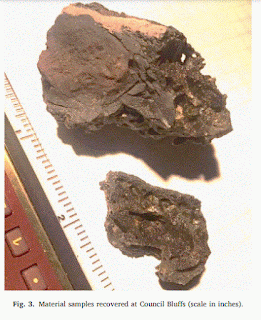
Section 3 "Investigating unknown material collected in the field: A Case Study" concerns an incident on the 17 December 1977, which occurred in Council Bluffs, Iowa. At 1945 CST "...a red, luminous mass was observed by two Council Bluffs residents, as it fell to Earth near the northern city limits..." At the scene the witnesses found an area "...covered by molten metal that glowed red-orange, igniting the grass. Police and fire brigade personnel who attended the scene within 15 minutes all saw the mass, estimated at 35-55 pounds. An investigation was conducted with three initial thoughts in mind. These were, an industrial accident, an aeronautical malfunction or a meteorite (despite there being no cratering.)  After investigations, it was concluded that it was not re-entering space debris; not falling material from an aircraft, not a meteorite, nor was it a hoax.  It was also noted that two witnesses of the eleven witnesses, described a round object hovering in the sky, edged by red blinking lights. 

The retrieved material had three components, namely "solid metal, slag and white ash inclusions in the slag." Vallee provided a piece of the original material for further testing. "...our initial conclusion was that sample components were consistent with a terrestrial origin." A recently developed Multiplexed Ion Beam Imaging" (MIBI) instrument was used which is capable of measuring a broader range of isotopes. Using this instrument investigators concluded that "All isotopic ratios were similar between the samples and did not show any statistically significant deviations from expected terrestrial normal except for 57Fe..." However, there was a suggested conventional explanation for this 57Fe deviation.

Speculative conclusions

Section 5, "Speculative conclusions" includes the statement:

"Our experience with the Council Bluffs case study shows how difficult such a determination can be, even when abundant evidence is collected within minutes of an event, supported by reliable testimony from multiple witnesses and in well-defined meteorological conditions."

The authors speculate about the hovering, round object edged with red lights;  that "Such an object might have ejected the mass of material observed by the other witnesses and recovered by police." They note that "The materials from Council Bluff show no evidence suggesting it was (sic) been engineered or designed. The material would not be expected to form naturally, and has been shown does have unusual inhomogeneity." 

Comments

1. An excellent, peer reviewed paper in a significant international journal, which introduces the topic to the broader aerospace community. 

2. Some UAP researchers might suggest that the paper doesn't go far enough in taking a look at other unusual samples associated with UAP. However, the authors note that:

"The objective is to provide data in an open-source manner so that others might replicate the analytic approaches or divine a testable hypothesis of why and how such materials are deposited or left behind . To many this will feel incomplete or insufficient, but this would be a premature conclusion. In the case of Council Bluffs, however, the data is verifiable...it is only the origin and nature of the material (and the phenomenon in general) that remains open."

3. On page 3 of the article there is reference to one of the Defense Intelligence Reference Documents produced by the Advanced Aerospace Weapon System Applications Program, namely the one on "Metallic Spintronics." 

4. There is also mention of the fact that the authors are conducting other analyses on other pieces of unusual materials. 

5.  All in all, it is the paper most of us were waiting for. Hopefully, just the first of many similar articles. 

Thursday, December 2, 2021

Eric Haseltine - former NSA - former ODNI writes on UAP

Psychology Today article

A 29 November 2021 article on the "Psychology Today" website, on UAP, is authored by former Intelligence Officer Eric Haseltine, who presents his thoughts on the topic.

Haseltine has been, in the past, the Associate Director, Research and Development, National Security Agency; and Associate Director National intelligence (between 2005-2007,) Office of the Director of National Intelligence, and oversaw all Science and Technology programs within the U.S. Intelligence Community.

Haseltine starts off the article by stating that he was frequently asked by friends, "Are UFOs real?" He says he was totally ignorant on the subject. He admits then, that he:

 "...was stunned when the Office of the Director of National Intelligence...issued a report this June."

After sharing a summary of part of the ODNI report he says, that assuming UAP are real then they represent either extensions of know science or exotic unknown science. He poses the question of whether UAPs could be "a sort of mid air projection that appears to be solid objects?" Perhaps UAPs have minimal or zero mass? Perhaps they are pushed/pulled by directed energy from a surface ship or above from an orbiting satellite? Could they be free air plasmas?

"Even though US scientists don't have directed energy systems capable of moving lightweight objects or forming plasmas that look and behave like reported UAPs; someone else theoretically could have developed such technologies and might have deployed it for reasons we can only guess...We don't know. But, given the Government thinks UAPs are real, someone, somewhere appears to have science that is...out of this world."

Acknowledgment: Thanks to Australian journalist Ross Coulthart for a link to this article. 

Pentagon Press Secretary John F. Kirby was asked another UAP related question

 Background

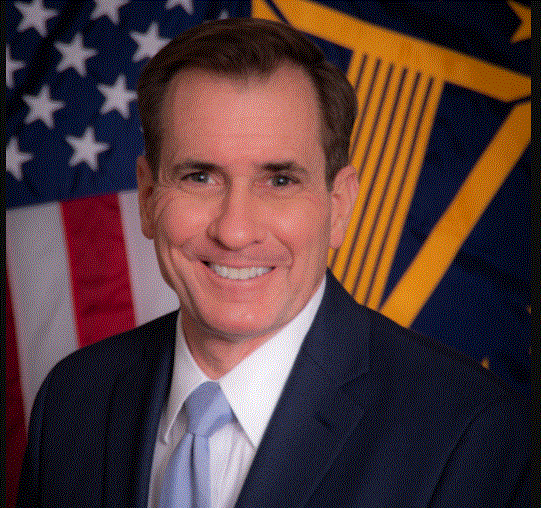
Pentagon Press Secretary John F. Kirby holds regular press briefings. On 1 June and again on 4 June 2021, questions were asked about UAP, which Kirby responded to.


29 November 2021

During a briefing held on 29 November 2021, Kirby was asked the following questions:

"Q: Thanks John. I want to ask you about this new UAP office that was created by Deputy Secretary Hicks and announced last week. The Aerial Object Identification and Management Synchronization Group was...

Mr. Kirby: Well put.

Q: That was a mouthful. Was there any consultation with lawmakers on Capitol Hill that are proposing related legislation like Representative Gallego and Senator Gillibrand? And secondly, some former Pentagon officials who had worked on this issue, Chris Mellon and Lou Elizondo said that this is an effort for the Pentagon to be less transparent on UAPs. And I was just wondering if you had any response?

Mr. Kirby: On the first one, I can't speak to pending legislation, obviously. I'd refer to those members. But we absolutely kept members of Congress informed as we fashioned this group together and announced it. And it , it is, to your second question, it is really designed to help us better coordinate the reporting process. The actual reports themselves, and the analysis of those reports. So that rather than getting them sort of piecemeal and ad hoc, as we've been getting them from the services, this is a way to coordinate the input, so that we can - there's a common set of parameters for how to report them and analyze them. And then to assess what we've got, and not all reports are going to manifest themselves in something that we consider a national security threat. So, this is a chance for us to be much more organized in the way we process these reports.

And, as we have, we will certainly continue to be as transparent as we can about these phenomena. And the impact that they may, or may nor be having on our ability to operate.

Q: Any specific commitment to release some data or information on these to the public at some point? And then beyond the briefed to Congress closed...

Mr. Kirby: Yes, I don't have a specific report to to announce today that, you know, on any kind of a frequent basis that we will do. But I can assure you that our intention is to be as transparent about this phenomenon as we can. Again, Travis, understanding that there will be national security considerations that we have to keep in mind, but we'll be as transparent as we can. But not, I don't want you to leave you with the impression that there'll be sort of a regular drumbeat of you know, of some kind of report that gets posted on a website, you know, every couple of months."

Update: 7 December 2021

Travis Tritten, from Military.com, was the journalist who asked Kirby the questions. Tritten published an article in the dated 7 December 2021.  

A blog update

Thank you to all those blog readers who have contacted me privately, to enquire as to why there has been no blog posts for several months. T...