Showing posts with label James E McDonald. Show all posts

Sunday, April 29, 2018

James E McDonald's interest in Project Blue Book cases - Warren, Michigan

Background:

This blog post continues my look at sightings from the USAF Project Blue Book files which interested the late Professor James E McDonald

The sighting:

At about 7.05 to 7.10 pm CDT (UTC-5 hours), on 18 August 1958, Alex Donald Chisholm, a business machine mechanic, aged 30, of Warren, Michigan (42:27N; 83:03W) was in his back yard when he observed a flight of four aircraft, which then drew his attention to an extremely bright "star," motionless in the sky at 70-75 degrees elevation, azimuth 300 degrees. The "star" was brighter than the Moon. He drew Walter Moilanion's (his neighbour) attention to it.

Chisholm then viewed the light through 8x30 field glasses, and then  again with the naked eye (through spectacles.) After 7-8 minutes, the object which had remained motionless until then, moved slightly. At this point, Chisholm (viewing through the field glasses) and Moilanion (with naked eye) pictured it as a circular object, light gray in colour, and shaped like the planet Saturn (as it was circular surrounded by a ring.) Chisholm estimated that the object was between 75-600 miles above the earth, and about 60 feet in diameter. After 30 seconds after first moving, it "vanished as if in a fast vaporised movement." There was no associated sound at any stage.

Documentation:

a. 18 August 1958 - a five page letter from the witness to NICAP.

Page 1 of the letter

b. 19 August 1958 - a three page report from 661st ACWRON Selfridge AFB.
c. 20 August 1958 - a three page report from 1st FTR WG Selfridge AFB.

Page from one of the Selfridge AFB reports

d. 25 August 1958 - a two page NICAP report form completed by the witness.

Page one of the NICAP report form

e. Undated - a two page letter from witness to NICAP which NICAP received on 27 August 1958.
f. It should be noted that the other male witness did not submit an independent report form.

Astronomical sky:

a. The Sun was three degrees above the horizon at azimuth 285 degrees. Thus the object was 15 degrees azimuth to the right of the setting Sun (sunset was at about 7.30pm) but 70 degrees higher up in the sky, The witness stated that the Sun was slightly above the horizon.

b. The Moon was at 21 degrees elevation; azimuth 235 degrees, i.e. 65 degrees to the left of the object, and 20 % illuminated. It was 4.3 days old. The witness however, stated that the Moon, although at last quarter was not visible in  the sky. This is incorrect.

Weather:

c. The witness stated that the sky was clear, no clouds were visible. The 19 August teletype from Selfridge AFB stated the sky was cloudless, and that the wind was blowing from 330 degrees, to 35 knots. Weather Underground shows that at nearby Detroit, Michigan, the surface wind was from the NNW (roughly 330 degrees.)

Source: https://www.wunderground.com/history/airport/KDET/1958/8/18/DailyHistory.html?req_city=&req_state=&req_statename=&reqdb.zip=&reqdb.magic=&reqdb.wmo=
Other details:

d. Most of my summary above is taken from the 18 August 1958 typed letter from the witness to NICAP.

e. Most interesting is the description of the way in which the object was lost to view:

1.  Documentation b says "object faded very rapidly without noticeable diminishment in size, vaporized."

2. Documentation a says "it vanished as if in a fast vaporised moment."

f. The object was not constantly viewed through optical aid for the entire observation.

Cause of the sighting?

The Project Blue Book documentation assigns an incorrect date of 17 August 1958 to the sighting. However, their  final evaluation was that the sighting was "unidentified."

Recent discussion on the NICAP googlegroups forum, centred around the suggestion that the object was perhaps a stratospheric balloon, launched from Anota, Minnesota on 17 August 1958.

Source: https://stratocat.com.ar/globos/1958e.htm
 Acknowledgment:

Thank you to Barry Greenwood from Boston in the USA, for supplying the NICAP letters/report form.

The full documentation may be read on the NICAP website. 

Tuesday, April 17, 2018

James E McDonald's interest in Project Blue Book cases - Pueblo, Colorado

Hi all,

Background

The late Dr. James E McDonald visited the former USAF's Project Blue Book on a number of occasions and gathered together a collection of sightings, which interested him. I published a blog back in February 2017,  about this aspect of his UAP work. As one of my 2018 projects, I am revisiting my earlier work on these selected Blue Book files.

Introduction

This blog post concerns one of the cases McDonald saw some value in, namely an observation by a weather observer, at a place called Pueblo, Colorado in the USA, which is near Colorado Springs.

Why bother re-examining these old cases? Well, they generally provide  me with data based observations, as opposed to sightings mentioned on Face Book pages, which provide hardly any data points. Secondly, it is always good to revisit/reanalyse cases, to see if a potential mundane explanation has been missed.

Case details

At 10:46am Mountain Standard Time (1746UTC), on 14 June 1958, a Pueblo, Colorado [latitude 38.28 deg N; longitude 104.6 deg W], airport weather observer, Orville R. Foster, aged 51 years, was observing a pilot balloon through a theodolite. He noticed an object enter the field of view at elevation 24.2 degrees,and azimuth 67 degrees (ENE.) He tracked the object across the northern sky (maximum elevation estimated as 50 degrees) on into the SW sky. Here he lost it in atmospheric haze at elevation 8.1 degrees, azimuth 237.2 degrees. The duration of the event was between 4-6 minutes.

The path of the object across the sky

The shape of the object at highest elevation was circular, with an apparently flat ring around the object, and a rounded dome in the middle. It appeared white to silvery white in colour. No metallic lustre was noticed. There was no smoke, no noise,no exhaust, and no vapour trail. There were cirrus clouds present at an estimated 30,000 feet and at times it went behind these.

The upper air winds during that day were from the SW - which is opposite to the direction that the object was travelling in, therefore it was going against the wind.

The observer noted that he had seen high altitude balloons through a theodolite before and this didn't look like them. On the USAF proforma Foster estimates its speed as a minimum 540 mph and, provides an estimate of its diameter as 30 feet.

Project Blue Book comments

The PBB file which I obtained a copy of, courtesy of Melbourne based researcher Paul Dean, showed two trains of thought about the nature of the object:

1. In a letter to the observer dated 14 July 1958 PBB made the statement that many qualified observers had mistaken a high altitude balloon for a UFO. It also stated "Routine checks and research disclosed that an upper-atmosphere balloon, flight No 161, was tracked continuously by the facilities of the AACS and last reported in the vicinity west of Pueblo between the 14th and 15th of June." Here, PBB was suggesting it might have been a high altitude balloon.

2. PBB "Routing slip" on the file stated "This is a toughie. I have approached it from every scientific and logical angle..after performing checks of a/c schedules (both military and civil), radar units, tests and operations, GCC, and others all showed negative..If no resolution, this will be one I must place in the category of 'unknown.'"

The routing slip
The "Project 10073 Record Card" conclusion is shown as "unidentified", "unknown."

The Project record card

Data analysis

1. If we assume that the object was at a minimum altitude of 30,000 feet, then we can calculate its range at three points.

a. Initial position of ENE sky at 24.2 degrees elevation.

Sine 24.2 = 30000/slant range.
0.4099 = 30000/slant range.
therefore slant range = 30000/0.4099.
therefore slant range is 73, 188 feet.

b. Intermediate position in northern sky at 50 degrees elevation.

Sine 50 = 30000/slant range.
0.766 = 30000/slant range
therefore slant range = 30000/0.766.
therefore slant range is 39, 164 feet.

c. Final position in SW sky at 8.1 degrees elevation.

Sine 8.1 = 30000/slant range.
0.1409 = 30000/slant range.
therefore slant range = 30000/0.1409.
therefore slant range = 212,917 feet.

If its actual altitude was above 30,000 feet, then these ranges would be greater than the figures shown.

2. We can calculate an average angular velocity across the sky.

190 degrees of arc traversed. Time taken, between 240 and 360 seconds.
Therefore average angular velocity was between 0.53 and 0.79 degrees per second.

3. In order to calculate an actual speed, we would need to know an actual figure for its angular velocity at one of the three known distances. We do not have this data.

However, Foster does provide a figure of a minimum speed of 540 miles per hour on the USAF profroma. This suggests that he used some form of average distance and angular speed to calculate this figure.

4. He also estimates the diameter of the object as 30 feet. As there is no data provided for the angular size of the object seen through the theodolite, we can only assume that he calculated this figure based on his 28 years of being a weather observer, and knowledge of the actual versus angular sizes of the balloons he tracked, and a comparison of the apparent angular size of the object in the instrument.

5.  The weather at the time was:

a. At the surface - as stated by the observer.

Scattered clouds.
Relative humidity 22%
Temperature 84.4 degrees F.
Slight breeze - 5 knots from SSW.

As given by the website weather underground

Temperature 82 degrees F.
Wind speed - 5.2 knots.
Wind direction From the south.
Barometer 29.75 inches Hg.

b. Upper air winds

The observer stated "Upper air winds during the day were from the south west quadrant."

I checked the University of Wyoming's global upper air readings database for Colorado Springs for that date. Unfortunately their records do not go that far back.

McDonald documents

US researcher Barry Greenwood located and forwarded three documents from his archives, which show that McDonald followed up the sighting in June 1970.


He contacted the US Weather Bureau in Pueblo, Colorado and asked them to check their logs for the sighting. The response stated that their observation log for 14 June 1958 contained the following entry:

"UFO sighted at 1046M while taking Pibal ob. Elev. 24.2 deg, azimuth 247.0; followed with theodolite for about 5 mins. Moved across northern sky, lost to view at Elev. 8.1 deg azimuth 57.2 deg. Color white, dome shaped in center, with circling ring. Higher than ci clds, moved very fast to SW."


There is a note that these azimuth readings are 180 degrees from true. Weather theodolites had South as 0 degrees azimuth.

With an address supplied by the Weather Bureau, McDonald wrote to Foster proposing a date for a telephone interview. We have no records of this interview, if it occurred.

Summary

An unusual object travelled against the upper air winds, at a speed which the observer estimates as at least 540mph, and was described as circular, with an apparently flat ring around the object, and a rounded dome in the middle, with an estimated diameter of 30 feet.  It appeared white to silvery white in colour. No metallic lustre was noticed. There was no smoke, no noise,no exhaust, and no vapour trail. The observer was adamant it was not a high altitude balloon.

I can see why PBB allocated it to the "unknown" category.

Acknowledgements

I wish to thank Robert Powell, and other members of the NICAP forum for their kind comments on my initial data analysis, which has been amended above based on their comments.

I also wish to thank Barry Greenwood for locating the documents which show James E McDonald's follow up of the sighting.

Sunday, October 15, 2017

Westall - and James E McDonald's files

Background

The late US researcher James E McDonald visited Australia in 1967. While here, he interviewed dozens of Australians about their UAP sightings, both by phone and in person.

Recently, the attention of Melbourne researcher Paul Dean and myself, was drawn, by US researcher Brad Sparks, to the University of Arizona's special collection MS412, of papers which had been gathered by McDonald.

On the University's special collections website there appears a listing of the contents of McDonald's boxes of papers. Among the listing for box one, is  a folder, 'Australian Miscellaneous Sightings: Slides, Sullivan, Westall School sightings.'

I am not aware of anyone who has accessed this folder. Therefore, I submitted an application to the University of Arizona to obtain a copy of the contents of the folder. After paying their fee, and waiting a few days, I received a WeTransfer of the contents.

What is in this folder?

1. 16 July 1967. 'The Sun-Herald' Sydney, New South Wales newspaper. Possible sighting of a flying saucer by Maggie Tabberer and Pat Firman.

2. 8 pages of 'Summary of Unusual Aerial Sightings reported to the Department of Air Canberra' 1960-1965. Sent by Peter Norris of Melbourne.

3. Envelope addressed to McDonald from VFSRS.

4. 30 Aug 1967. 'Mercury' Hobart, Tasmania newspaper. 'UFOs seen over state.'
    30 Aug 1967. 'Advocate' Burnie, Tasmania newspaper. 'Three UFO sightings.'

5. 5 May 1967. 'Bairnsdale Advertiser' Bairnsdale, Victoria newspaper. An earthquake in Victoria.

6. 30 Aug 1967. 'Advertiser' Adelaide, South Australia newspaper. '"Space systems" may be watching us.'
    30 Aug 1967. 'Examiner' Launceston, Tasmania newspaper. 'We are being watched.'
    30 Aug 1967 'The Mercury' Hobart, Tasmania newspaper. 'Scientist claims eyes from space may be watching.'

7. 25 Aug 1967. 'Advocate'  Burnie, Tasmania newspaper. 'UFOs seen by four.'
    30 Aug 1967. 'Telegraph' Sydney, New South Wales newspaper. 'Saucers.'

8. Envelope addressed to McDonald.

9. Letter dated 5 Sep 1967 to McDonald from Francis L Rose.

10. 4 pages re McDonald's appearance on ABC TV show.

11. 19 Mar 1967. 'Mail' Brisbane, Queensland newspaper. St George-Mitchell sighting.
      26 Mar 1967. 'Courier Mail' Brisbane, Queensland newspaper. 'Spotter in dark over 'saucer.''

12. 23 Mar 1967. 'Journal' Traralgon, Victoria newspaper. 'What is the noise?'
       11 Mar 1967 'Sunraysia Daily' Mildura, Victoria newspaper. 'What is it?

13. Undated newspaper 'We saw flying saucer over Hallam.'

14. 14 Nov 1963. 'Wonthaggi Express' ''More see a UFO.'

15. 31 May 1963. '?' newspaper, Sydney. 'Flying saucers just 'poppycock.''
      30 May 1963. 'News' Adelaide, South Australia newspaper. 'Object in sky not a meteor.'
      30 May 1963. 'Mirror' Sydney, New South Wales 'Mystery light over Canberra.'

16. 31 May 1963. 'The Age' Melbourne, Victoria newspaper. 'Mystery object in Canberra sky.'
      30 May 1963. 'Telegraph' Brisbane, Queensland newspaper. 'A saucer sighted by scientists.'
      31 May 1963, 'The Sun' 'Canberra saucer was vampire jet.'

17. Ballarat Astronomical Society 1965 UFO conference.

18. 2 pages. 'Experiences with UFOs' by W H Sloane.

19. 3 pages. Ballarat observatory.

20. Program. Ballarat UFO conference 1965.

21. 29 Jun 1967. Letter from W H Sloane to McDonald.

22. 10 Jul 1967. ? re WRE.

23. 21 Jul 1965. 'Telegraph' Sydney, New South Wales newspaper. 'The thing on the beach.'

24. 24 Apr 1965. Letter to VFSRS from Len Langford re sighting in September 1962.

25. 13 Mar 1965. 'Sydney Morning Herald' Sydney, New South Wales newspaper. 'My flying saucer-Keith Hooper.'

26. Uncited newspaper. 'Moon object pics.' Iron Duke ship photographs.

27. 31 Dec 1965. Letter to Paul Norman from Observatory Adhara.

28. 28 Jun 1967. Letter to McDonald from Sydney radio station 2GB.

29. 7 Nov 1963. 'The Express' Wonthaggi, Victoria newspaper. Bread carter sighting.

30. UK Flying Saucer Review article, Jul-Aug 1966 re Westall.

31. 21 Apr 1966. 'The Dandenong Journal' article re Westall.

32. Sheet - hand written note. 'Westall School. Misc notes 5/20/67. Aust FSR no 5 p13 for Greenwood's account.

33. 14 Apr 1966. 'The Dandenong Journal' 'Flying saucer mystery.'

Notes

As can be seen, the folder contains information about miscellaneous Australian sightings, but nothing of significance about the 6 Apr 1966 Westall event. However, it should be noted that McDonald did conduct a face to face interview with Westall witness Andrew Greenwood. To read a detailed summary of this 1967 Greenwood interview, click here

To read detailed summaries of all the 1967 Australian witness interviews by McDonald, compiled by Sydney researcher Anthony Clarke and myself, click here.

Monday, October 9, 2017

Westall - and the CSIRO

In a recent Facebook post, on the Westall Flying Saucer Incident Facebook page, Victorian researcher George Simpson made reference to an account where the CSIRO was reported to have removed soil from a location in Westall.  I had previously explored the UFO interest of one CSIRO scientist, who actually investigated the 6 April 1966 incident. Below I repost my 2015 blog post on this scientist.

Felician Andrzej Berson - the CSIRO - and his interest in UAP


Introduction:

There are scattered references, in the civilian UAP literature, to the interest of an individual named Dr. F A Berson, who worked for the Commonwealth Scientific and Industrial Research organisation (CSIRO). I thought it might be useful to bring these references together, hence this post.


Dr F A Berson
(Source: Garratt, J et al.  "Winds of Change." CSIRO publishing. 1999. Out of print.)

Biography:

Firstly, before investigating his interest in the subject of UAP, I present a biography which I found in an article "Clouds on the Horizon" written by Berson himself, which appeared in  volume 72, number 2, February 1991 of the Bulletin American Meteorological Society.

Berson decided to study meteorology and qualified for his doctorate in 1934; then worked at the Swedish Meteorological and Hydrological Institute; followed by the Polish State Meteorological institute until 1939. Berson then moved to England where he joined the RAAF as a meteorologist, during the second world war.

In 1946, one of the items on his research list concerned cold fronts. After the war he accepted a post with the Swedish Meteorological and Hydrological Institute. Berson writes that at one point (about Carl-Gustav Rossby) "He appreciated the fact that I had imagination and was anything but institutionally inclined, he also enjoyed the eccentric behaviour I displayed on occasions.  p.208.)

In 1952 he "...applied to join the rapidly growing group of English wartime colleagues led by C H B Priestley forming the section (later Division) of Atmospheric Physics in the Australian Commonwealth Scientific and Industrial Research Organisation (CSIRO) at Aspendale near Melbourne." (p.210.)

Between 1953 and 1974, when he retired, Berson worked at the CSIRO, and was known as Andgei to his colleagues. He researched cold fronts, Antarctic circulation; quasi-biennial oscillation; convective systems and interpreting radar echoes. During this time he worked for a period at the International Antarctic Analytical Center, and another period of time at the US Weather Bureau in Washington, DC. He also spent time at NCAR's National Hail Research Experiment at Boulder and Grover, Colorado in the US.


Ca. 1956:

According to Berson himself, in a letter, dated 28 November, 1966, to Robert Low of the famous Condon Committee, he became interested in the topic of UAP around 1956:

"It was in fact Mr Groodin who first got me interested in the subject. This was some ten years ago. I have since had one or two contacts in this matter, with Government departments, but have established closer contacts with a private agency in Victoria in an endeavour to find out what they were up to and whether scientific research was feasible."

According to Garratt, J; Angus, D and Holper P. (1999. "Winds of Change." CSIRO publishing, page 13,)  Ivan S Groodin was working for the CSIRO's Atmospheric Physics section from 1953, and was there at the time Berson joined that same section.

Ivan S Groodin in a group photograph.
(Source: "Winds of Change." CSIRO Publishing. 1999.)

March/April 1963:

Dr Berson investigated the 15 March 1963 Willow Grove, near Moe, Victoria, case. In an interview between Peter Norris of the Victorian Flying Saucer Research Society, and the witness, Charles Brew; Brew says:

A. "...the CSIRO were here and number one question as far as they were concerned - he asked me did I get a headache. I said..."

Q. "What did the CSIRO man say? Incidentally, do you know his name? What's his name?"

A. "Er, Mr Berson. Yes, Mr Berson was his name."

Q. "And what did he say about the headache?"

A. Well, he said, 'that ties in with what our theory, we always had the impression that it was ..." (what would you say) he gave me the impression it was electro-magnetic or something to that effect - that's beyond me - but he said that would more than likely cause a headache  and it certainly took all day to get rid of it, anyhow. I know that."

Q. "What else did the CSIRO do?"

A. " Well, as I said, he took away samples of rock - they were very interested in that - because he said being a sort of an ironstone, it may have some attraction for it. And there is the reef as I said..."

Q. "How long after the sighting, did the CSIRO come down here?'

A. "They were here about 4 days after..."

On 8 April 1963, Dr Berson wrote to Sylvia Dutton of CAPIO, advising that:

"I visited Mr Brew in company of a friend of mine, but we did not take any rock samples. But I know that somebody else did. To obtain more information about the mentioned sighting, please contact the RAAF Department of Air, Canberra who are investigating this case." 

The following is from a letter from Berson to Robert Low, dated 11May 1967:

"...among them a sketch of the distribution of total magnetic intensity (as recorded by an AN/ASQ-1 airborne magnetometer installed in a DC3 aircraft) in a part of Gippsland surrounding the site of the Willow Grove sighting."

Later, in the same letter Berson suggested:

"Following a discussion with a geophysicist in the Antarctic Division of the Department of External Affairs I venture to suggest to you that a statistical investigation should be made on the following lines: place and/or time of (low level?) sightings of high credibility rating be correlated with magnetic data such as the three hourly geomagnetic k index at observatories and the world-wide kp index." 

Who was Berson's companion on his visit to Moe in 1963? Berson mentioned he was accompanied by a Mr Clarke. On the website for the Encyclopaedia of Australian Science http://www.eoas.info/P003236b.htm I found the following information:

Reginald Henry Clarke ( (1914-1990) joined the Bureau of meteorology in 1940, and then joined the CSIRO's Division of Atmospheric Physics at Aspendale in 1957. He retired in 1978 and passed away in 1990. One of his research interests was the subject of tornadoes.


Reg Clarke
(Source: "Winds of Change." CSIRO Publishing.1999.)


19 September 1963:

On Thursday 19 September 1963, Berson had his own sighting. I found the following information in an interview between Berson and James E McDonald dated 29 June 1967.  As far as I can ascertain he was at home in Mt Eliza, Melbourne at the time. He was with his son, when they noticed a cherry-red light in the sky. Far from being a point source of light, he estimated it had an angular size of one quarter of a degree, i.e. half the diameter of the full Moon.

The object appeared stationary, and there was no associated sound. He went inside the house to fetch binoculars, but when he came out, his son said that the object had formed two objects, and disappeared.

There was a newspaper report that an object was also reported from the Melbourne suburb of Dudley South at the same time. He checked the azimuth direction of his observation (it had been near a tree or similar object) and the track passed over Dudley South. He deduced that the object was not a balloon, or a hoax.

I found additional information on page 77 of the book by Michael Hervey, titled "UFOs over the Southern Hemisphere." (Click here.)

"On September 19, 1963, at approximately 8pm, the VFSRS received a telephone call from a man living at Mt Eliza. He and his family had watched an unusual object in the sky a little earlier that evening. The object, about 20 to 30 degrees above the horizon, appeared blood red  and was blinking on and off. It seemed larger than a star and made no sound. The object disappeared in a slightly easterly direction." 

"The Express" Newspaper of Wonthaggi, Victoria in its 26 September 1963 edition provided some other information. At 1845hrs South Dudley children at a playground saw an object. An orange ball was seen to the west. There was no sound. Tom Lymer reported "It was flashing on and off like an aeroplane light" but bigger and brighter. It was moving much slower than an aircraft. Suddenly flame shot out and it travelled at a tremendous speed. It was lost for a while then picked up to the south, hovering. Tom Ruby said that after hovering and still flashing on and off, it moved over the sea and disappeared. It was reported that television reception was affected.

The Australian Flying Saucer Review, May 1964, page 1 said that a John Waters, 17 saw two objects. "One appeared first, travelling in an area but not stopping, and the second object came over a little higher and followed the same trajectory." Mrs Sutton said that the Mt Eliza man's object was travelling in a south to south-east direction. Mrs Sutton checked with the RAAF, weather bureau and the Department of Civil Aviation and said that there were no balloons, kites, planes etc in the area at the time.

McDonald in his handwritten notes of interview with Berson wrote that the object was "Not blinking. Review is in error."


April 1966: The Westall incident:

In Ann Druffel's book on James E McDonald, "Firestorm" (click here) she wrote that

"Dr Berson had done his own investigation of the Westall High School sighting. He'd called Moorabbin airport also, but had been told he would have to call four separate companies in order to try to track down the source of the five Cessnas! He'd learned that students at Clayton school had also seen the object at the same time. he went to the Department of Air, but was given no information. There he was told by an aviation instructor, "We have a sub-chasing aircraft with very bright lights that can be misinterpreted."  The Australian officials were reaching as far afield for 'explanations' as project Blue Book."

Berson himself refers to this incident, in a letter to Robert Low dated 28 November 1966. In part it reads:

"On another occasion I established the fact that a similar D.A. team had appeared so quickly on the scene of a sighting made by a group of school children and a teacher in the vicinity of an aerodrome as to make one believe that they had some foreknowledge.The teaching staff was asked by the DA men to "play it down" and the sighting was promptly ridiculed, but quite independently another group of people had reported the unusual phenomenon from the opposite peripheral area of the aerodrome." 


July 1966:

An article titled "The Tully Nests: How freakish can whirlwinds be?" appeared in the Australian Flying Saucer Review, number 5, dated July 1966 pages 3-7. The article was "written by a member of VFSRS who has been connected with studies in atmospheric sciences." The references include an article by Reg Clarke. This may have been written by Berson.


May 1967:

In the McDonald archive section of Dr Michael Swords' digital file  collection, I found a letter dated 26 May 1967 to Dr Berson from James E McDonald. McDonald advised Berson that he was visiting Australia in June and July 1967. In part it read:

"I am now convinced it is a problem warranting greater increased scientific attention by a much larger group of workers...In going over one account of the Brew case, near Moe, Australia, I have noted that you are cited as a CSIRO investigator who looked into that interesting case. I should like very much to discuss that and any other Australian cases of which you have direct knowledge...I should like very much to speak to some of the CSIRO meteorologists about this entire problem...I might mention that I know...Priestley and Swinbank of your group."


June 1967:

Also in Swords' files is a letter dated 10 June 1967 from Sylvia Sutton, CAPIO to McDonald. In part it reads:

"The Chief purpose of this letter is to invite you to dine at my home...Dr Berson of the CSIRO, with whom you have been  corresponding, has become a good friend of my family...so I have invited him and his wife to join us. He was particularly pleased about this because he would have liked to arrange some social occasion at his own home at Mt Eliza but due to the travelling distance, this rather ruled it out..."

McDonald met Berson on a number of occasions whilst in Melbourne, Victoria.

In the Australian journal of James E McDonald I found an entry dated 29 June 1967:

"then to Berson office to see geomagnetic anomaly at Brew site, and interviewed Berson re his Sep 19, 1963 sighting. Met Eric Webb who's been interested in UFOs (?) for some time but not until few weeks back did Berson learn of that..."

Eric Webb also worked also worked for the CSIRO.


Eric Webb
(Source: "Winds of Change." CSIRO Publishing. 1999.)


Another McDonald entry dated 30 June 1967  read:

"Phoned Berson. He wants me back. Priestley back and quite interested."


July 1967:

Another entry dated 4 July 1967 reads: "Paul and Geoff drove me to the CSIRO, Aspendale, met Priestley and Deacn (?) and Dyer."


CSIRO files on UAP:

The National Archives of Australia holds two relevant CSIRO files. File series A9778, control symbol M1/F/31, date range 1952-1957 is titled "Flying Saucers."


File series A852, control symbol HM1/30 titled "Miscellaneous Enquiries - General - UFOs."


 Is there anything on these files about Berson's UAP interests, or indeed about that of Groodin? I failed to find anything, however there were three items of general interest:

1. A memo dated 26 June 1968 from the Department of External Affairs addressed to the Secretary, Prime Minister's department, Canberra cc'd to Dr D F Martyn. Officer in charge, Upper Atmospheric Section CSIRO, about the Condon committee in the USA. However, the Upper Atmospheric Section was in Camden, New South Wales and not Aspendale, Victoria.

2. In the period 1959 to at least 1965, a copy of UAP reports were sent to the CSIRO, from the Department of territories (Papua New Guinea). There is no mention of which section/division of the CSIRO they ultimately ended up with.

3. A memo from the Department of Air, to the CSIRO dated 28 November 1968 advised that:

"During the course of an investigation into the unusual sightings made by Mr A S Ricketts of Baccus Marsh, Victoria, it was learnt that a 'team of CSIIRO scientists" had visited him on 7th July 1966. This Department would be grateful for any information on this visit that could be of assistance in assessing the origin of Mr Rickett's sightings."

 On 5 December 1966 the CSIRO replied:

"I have made inquiries from several likely CSIRO Divisions, but with negative results."

RAAF file 580/1/1 Part 6, held by the National Archives of Australia reveals a detailed investigation report on multiple observations by Mr Ricketts. It included:

"Mr Ricketts had a visit from a team of CSIRO scientists who saw something but would not confirm that this that this was a UFO. Mr Rickett's would not divulge the names of the CSIRO scientists."

Monday, June 12, 2017

James E McDonald - where did his UAP interest come from?

Paul Hellyer

My former co-blogger, Pauline Wilson, at one time, was intrigued about where the UAP interest of certain researchers came from?

In a blog dated 6 May 2011, she started her enquiries with Paul Hellyer, a former Canadian Defence Minister, who was then in the news, making statements about UAP. Pauline found that his '..UFO opinions derived from reading Colonel Corso's book rather than official knowledge.' (According to Bullard, T E, 2010. 'The Myth and Mystery of UFOs'.University Press of Kansas. Lawrence, Kansas. p.9.)

Image courtesy of Amazon Books

Peter A Sturrock


Image courtesy of Amazon Books

In a further blog post dated 26 July 2011, Pauline, after reading a book by Peter A Sturrock titled 'A Tale of Two Sciences: Memoirs of a Dissident Scientist'. (2009. Exoscience. Palo Alto, California) wrote ' that Sturrock, in 1947, while in the English countryside, had seen, in the sky 'A round, bright white object...travelling in a straight line, seen for less than a minute' (p.1.) This impressed him.

J Allen Hynek 


Image courtesy Amazon Books


She went on (blog post 11 August 2011) to write about J Allen Hynek's interest. She found the answer in Jacques Vallee's book 'Forbidden Science Volume 1,' (2002. Documentica Research, LLC.) page 277. In a diary entry, dated November 1966, Vallee wrote:

Image courtesy of Amazon Books

[Hynek to Vallee] 'Did I ever tell you how I became interested in science?'

'Wasn't your mother a schoolteacher? You told me she once gave you a book about astronomy that fascinated you.'

'That's not what made me decide to take up science as a profession. So many people get into science looking for power, or a chance to make some discovery that will put their name into history books...For me the challenge was to find the very limits of science, the place where it breaks down, the phenomenon it didn't explain.'

James E. McDonald

Re-reading these blog posts made me wonder where the UAP interest of James E. McDonald came from?

I went to Ann Druffel's book about McDonald ('Firestorm.' 2003. Wild Flower Press. Columbus, NC.) to try and find the answer. The first relevant reference I located was on page 2.

Image courtesy of Amazon Books

'McDonald's friend and colleague, Dr Paul E Damon of the University of Arizona, feels that McDonald's intense interest in UFOs may have started in the early fifties at an international meteorological conference in Italy. There had been a new report of an Italian UFO sighting which intrigued McDonald.

He discussed the sighting with some senior colleagues at this conference. They reminded him that the United States Air Force had a group, Project Blue Book that was specifically in charge of investigating UFOs. These colleagues reasoned that, if there was anything to the report, the Air Force would have found this out and would have alerted the scientific community.  This satisfied McDonald for a while but in 1958 when public UFO reports in his home town of Tucson began to come to his attention, McDonald''s curiosity was piqued. And when his friends and colleagues also began to confide their own sightings to him, he felt it was vitally necessary to study the question.' (Interview between Ann Druffel and Dr Paul E Damon, 27 February 1994.)

Page 15 of 'Firestorm' provides the additional information that 'McDonald had himself seen a bright, anomalous object in the daytime sky when he first came to Tucson in 1954.' Druffel summarised this sighting and notes that McDonald wrote a letter to the USAF detailing his observations.

The letter

Through US researcher and historian, Barry Greenwood, I obtained a copy of this letter. As very few blog readers would have had the opportunity to read this letter, I present part of the contents below.

'On Sunday, January 10 of this year [1954-KB], at 1725MST, while driving north along Arizona State Highway 83, about five miles north of Sonoita (latitude 31deg 45min, longitude 110deg 40min) I observed an unusually brilliant object low in the south western sky. As viewed from our level, the sun had just set behind the Santa Rita Mountains even though nominal sunset for a level plain in this vicinity would be about 1740MST. I estimated that this object was only one or two degrees above the crest of the range of mountains and that the latter rose to an altitude angle of perhaps five or six degrees, from our position.

Its exact azimuth was uncertain to me at the time of observation since this was unfamiliar territory with no landmarks, but since my return to Chicago, I have determined from astronomical tables that the sun's azimuth at 1725MST near Tucson was approximately 243 deg and this bright object lay no more than five degrees southward of the sun in azimuth according to my estimate,

Hence, when seen from the approximate position cited above, this object was at altitude six to eight degrees and azimuth 235deg to 240deg. The altitude may have been even below 6 deg...the luminosity did not vary as we continued our sinuous way northward. I pointed the object out to my three companions...it became evident that the object was either not moving with any perceptible velocity across out line of sight or that it was doing so intermittently...we held it under observation for a total period of was about fifteen minutes...the mountain blocked out view...Its light was white...the sky was cloudless.'

In looking for an explanation, McDonald considered whether or not it was the planet Venus; a weather balloon; and also looked at the weather at the time.'Above a shallow layer of easterly winds, the circulation over the southwest US on the afternoon of January 10 was westerly. Tucson's 500mb winds were southwest 30 kts at both 0800MST and 2000MST.. I would estimate magnitude -5 to -7...' (Source:  letter from McDonald to USAF, 1954.)

The object seen by McDonald and his companions, remained unknown.

'There had been a new report of an Italian UFO sighting which intrigued McDonald.'

I checked Fold3 Project Blue Book records looking for some Italian cases from the early 1950's. I found two possible cases, which were:

1. 14 September 1954. Italy.

'The inhabitants of Pitigliano reported sighting a round, white object making a strange, loud noise. The object came to a standstill and then disappeared at high speed. ATIC Eval: Unknown-insufficient detail.'

2. 17 September 1954. Rome, Italy.

One, soundless object, the shape of a jellyfish when stationary, but cigar shaped when in motion. It was silver in colour, with red/violet streaks along one side with a circle of dark grey/black beneath. Seen in the sky. Seen from control tower of Ciampino Air Base. Object approached from 270/280 degrees azimuth.Approached to about 30 km distance, descended to altitude of 6000 to 10000 ft. Remained stationary. Then moved north to 290 degrees azimuth. Gained altitude then moved to west to 270 degrees azimuth. Lost at azimuth 270 degrees, at a low elevation. In sight for 30 minutes clearly then for occasionally for a further 15 minutes. Seen with naked eyes and through binoculars. Also reportedly tracked by radar, but radar report not available to PBB. Seen between 1645Z and 1715Z clearly and occasionally until 1730Z 17 September 1954. Just before sunset and seen towards the sun. The report also made the newspapers.

It is not possible to be certain if either of these reports was the one referred to by Druffel, though the second one would certainly have intrigued McDonald. I also failed to locate details of any Italian meteorological conference in the early fifties, which might have provided a more accurate date for the Italian sighting which intrigued McDonald. However, it would seem reasonable to suggest that McDonald's interest came from an Italian sighting of the early 1950's, and his own 10 January 1954 observation.

A small aside

The USAF apparently took no action about McDonald's 1954 letter, apart from an acknowledgement of the letter. So, how do we know about the letter today? In Vallee's 'Forbidden Science Volume One' pages 254-255, Vallee relates that on 15 April 1967, he was at Hynek's house sorting through files.

'...I stumbled on something I felt was important. I found it among the relics of Project Henry. It was a simple letter dated 1954. It came from a cloud physicist at the University of Chicago who was studying for a doctorate at the time. Together with three other physicists he had seen a bright unidentified object in the sky over Arizona. The letter gave precise details and calculations. It was signed James McDonald.' 

Can any blog readers add any additional information?

Friday, June 9, 2017

An Australian witness to a 1926 sighting in the UK

I was re-reading a set of hand written notes by US researcher James E McDonald, which he wrote while in Australia in 1967. This material was obtained many years ago when a group of US researchers, including Dr Michael Swords, reviewed the McDonald collection at the University of Arizona.

Some of the notes were made at the same time that McDonald was interviewing witnesses to selected Australian sightings.


One of the sightings documented was from the UK in 1926! I thought it would be of interest to provide the details which McDonald recorded. McDonald's handwriting is very difficult to read at times, so in the following text, the use of (-) indicates that a word is illegible to me.

The individual whom McDonald interviewed was Mrs Mary Kibel of Melbourne.

'Was age 15 in Scotland. One (-) but permission to a charity concert at Scremerston, Northumberland. Home was in Berwick on Tweed.

Winter 1926. East Coast Scotland. Lived at sea level. Had to take a road from home and little traffic. Came down from (-). 4 - 2 boys and 2 girls. Talking and laughing. Suddenly a terrific swoosh. All (-) cowered. Road had a  high hedge (-). 12-15 ft high. Object swooped over hedge and over to field. All was cowering. Noise was (-) (-). Brilliant red and blue white. (-) glow. (-). Banding of colors. Swept over it +50ft. Went too fast to see shape but feels it was possibly round.

(-) (-) near to village, into homes. She (-) into houses, told by parents it was a falling star. Next AM, all decided if it was a falling star, must be in field. But when checked found nothing, so decided to forget it.

Three zones of color. White in middle, red on top, blue at bottom. She recalls saying to aunt it was colored just like the red-white-blue lifeboats at (-) station.

Hedges were ca. 25 ft apart. Object must have been 20 to 25 ft diam. It did not get down onto the roadway. Came d. a bit. Subtended ca. 20 degree angle. She (-) over.

Girl was Edith Ward (now Mrs Bruce.) Boy was Athol Whitfield (killed in war), John Brown also killed in war.'

Sunday, February 19, 2017

James E McDonald's radar-visual cases

Hi all,

Introduction

In early 1966, James E McDonald made his first trip to the USAF's Project Blue Book (Druffel, A. 2002. 'Firestorm.'  p.55.) Among other things, 'That afternoon, McDonald read about 80 case reports.' (Druffel p. 57.) Subsequently, he reviewed many other case files on the visit. He copied a number of case files to take away with him,

Image courtesy of Amazon Books

McDonald made a second trip to Blue Book, at the end of June 1966. (Druffel, p.137.) A third visit took place the next month. (Druffel, p.143.) 'In spite of McDonald's interest in numerous types of UFO reports, he realized that only those reports where documented proof could be obtained would convince the scientific community that UFOs were real. Two types which seemed to hold out hope of proof were: 1. Photo cases which held up under the most careful scrutiny; and 2. Radar-visual cases, where the objects were seen visually and monitored on radar at the same time.' (Druffel, p.287.)

'Reading that the Condon Committee had had access to R-V cases which were not known to the UFO community, he decided to visit Wright-Patterson AFB again to search for them. 'At the end of June 1969...He spent the next two days  going through the files for the fourth time and hand-typed notes on 18 cases. On this trip he carried with him a list of cases, mostly R-V, which he was most interested in tracking down.' (Druffel, p.337.) 'On his fourth Blue Book visit, McDonald was still denied access to classified R-V cases.' (Druffel, p.338.)

'...on May 18 (1970?-KB) he was hard at work in the Historical Division, Aerospace Science Institute at Maxwell AFB in Montgomery, Alabama...But once he started studying the R-V files, McDonald realized he'd struck a bonanza. He spent an extra week there, copying literally hundreds of them...Greatly stimulated, he brought the files home and spent the next two weeks studying each case...' (Druffel, p.478.)


Where did these case files go?

Californian researcher Ann Druffel, worked with the late James E McDonald's wife, Betsy, to relocate McDonald's files to the University of Arizona.

In the August 2006 (number 460: pp 5-10) issue of the MUFON Journal, Ann Druffel, Vincent Uhlenkott and Ralph McCarron, published an article titled 'Scientist, ufologist James E McDonald's voice speaks again to researchers.'

MUFON Journal Aug 2006 issue

'Shortly before McDonald died, he wrote a letter to Betsy, stating his concern that his voluminous UFO files not be simply burned after his death, but archived in some form so that capable researchers could use them in further studies on the UFO phenomenon. Of particular concern to him were hundreds of Blue Book radar-visual (RV) sighting files which he had acquired in 1970 at Maxwell AFB, a few months after Project Blue Book was officially ended.' (Druffel et al, 2006, p.6.)

The University of Arizona Library's Special Collections Section agreed to house them. 'The Collection continues with the 580 Project Blue Book R-V files photocopied by McDonald at Maxwell AFB. These are in four boxes, filed chronologically by date, as McDonald originally arranged them. The dates on these R-V files begin with "June 1947, Hamburg, NY" and ends with "July 11, 1968, Nielson AFB, Alaska." (Druffel et al, p.7.)


University of Arizona

I visited the website for the University of Arizona's Special Collections - McDonald's UFO material. The MS412 collection summary in the 'scope of and content note', in part, states 'Contains photocopies of approximately 580 Project Blue Book sighting reports, mostly by pilots and some with airborne and ground radar verification.'

I copied the list of 'Series 2: Project Blue Book, 1947-1968,' to my computer. Indeed, as Druffel et al stated in 2006; the list starts with 'Hamburg, NY, June 1947 and ends with 'Nielson AFB, Alaska July 11, 1968.'

I noted that Druffel et al (2006) speaks of '580 Project blue Book R-V files,' while the University of Arizona's collection notes speaks of 'approximately 580 Project Blue Book sighting reports, mostly by pilots and some with airborne and ground radar verification.' So, at this point of my research, I was unsure whether or not all the 580 cases were R-V.

I therefore contacted a couple of senior US researchers and asked for their thoughts on this topic.

Researcher one, who wished to remain anonymous stated 'The McDonald papers at UA Tucson have approximately 20,000 to 22,000 pages, of which only about 7,000 pages have been copied by a CUFOS-led coalition nearly 20 years ago, and an unknown amount of the 7,000 pages digitised...How much is Radar-Visual is difficult to say...'

Researcher Jan Aldrich, responded 'Dr Michael Swords led a team of researchers to the University of Arizona on a two week look at McDonald's files...No one was looking for RV cases as a collection.'


An aside

The previously mentioned August 2006 MUFON J article stated, in part,'...Australian scientist inquired about the Blue Book R-V files..she [Betsy McDonald] allowed him to copy the R-V files...' As far as I can ascertain, no Australian, and indeed no global researcher, has copies of these copies of these R-V files.' The consensus among those I have asked about the identity of this Australian scientist, is that it was probably, Dr Michael Duggin.


Research work

I have been undertaking some work on this subject. I retyped the list of McDonald's approximately 580 Blue Book case files into an Excel spreadsheet. I then added references to such cases which I found in the records of the Michael Swords digital collection; and also cases found in Brad Sparks' 'Comprehensive Catalog of 1,700 Project Blue Book UFO Unknowns' version 1.27 dated Dec 20, 2016.
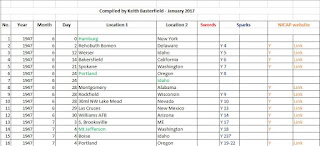
A section of my draft Excel spreadsheet

In addition, I checked each listed case against those held in the chronology section of the NICAP website. Noting that there were a number of cases, on McDonald's list where there was no NICAP chronology listing, or a detailed entry in the Sparks' catalog, I utilised Internet sources such as the Fold3 Project Blue Book documents, to prepare a case file summary, and a PDF file of the available documents. I have an ongoing project to do this for as many cases as possible, and am periodically submitting these to the NICAP website for use there.

Below, are two examples of the R-V cases, which appeared on McDonald's list.


July,11, 1968; Eielson AFB, Alaska

Visual observation

At about 0300hrs local time (1200Z) on 11 July 1968, three control tower personnel (aged 20,31 and 32) observed a bright, round orange coloured, self-luminous, solid, sharp-edged, object in a clear area of a partly cloudy sky. It was observed both with the naked eye and through binoculars. After 25 minutes, it was lost to view due to solar illumination (the Project Blue Book documents provide the time of sunrise as 0239hrs local) and haze in the atmosphere.

The estimated angular elevation was in the range 7-12 degrees. Two of the three men specifically stated that the object rose higher in the sky between 0300 and 0325hrs local, while the third man indicated it had moved but didn’t indicate whether it had risen or fallen in elevation. Their estimates of the object’s azimuth ranged from an initial position (180-195 degrees) to a final position (190-202 degrees) with one man stating his estimate as mag (magnetic.) Based on sketches drawn by the three men the object’s angular size can be calculated as in the range 0.2 to 0.3 degrees (Moon is 0.5 degrees.)
The tower contacted Major Gammon, 6th Strategic Wing supervisor. He reported, that at 0340hrs local he arrived at the tower, but by this time the tower had lost sight of the object. He could see nothing with his naked eye, however, based on RAPCON’s radar report, using binoculars, he picked up a dim object in the haze at 10-15 degrees’ elevation. It faded from view by 0345hrs local.

Radar observation

Donald A Sproul ATCS(T), Eielson RAPCON (Radar approach control) stated that he was contacted by the tower at 0405hrs ADT (Alaskan Daylight Saving Time.) He had noted a radar target at 18 miles, bearing 140 degree mag (SE-KB) (29 degree variation from true) from their radar antenna.

The target’s initial position was about 2 miles south of the Harding Lake tower on a SW heading. After 10 minutes, it turned; headed E; and 5 miles south of its initial point, headed SW. Then it slowed to 30 knots.  Observed for a total of 35 minutes and faded 10 miles E of Cold King airport. Two targets were noted on the observed track for ¾ of the paints. 10 minutes before it faded, two additional targets appeared at the same point as the original target first did. These tracked awhile then split into two targets, 15 miles SW of Harding Lake tower. One followed the rough track of the first object, but the second tracked due W and was lost 30 miles S (180 degree magnetic from the antenna.)

A check was made with 744 ACW Squadron at Murphy Dome (22 miles W of Eielson AFB.) However, no radar or visual sighting was made by Murphy Dome.

Project Blue Book analysis

There were no known aircraft in the area; nor any balloons. There were no unusual weather phenomena noted.

Project Blue Book concluded that the radar observations were probably due to anomalous propagation (Sproul talked of ‘ghost’ returns in his report.) Project Blue Book concluded that the tower visual observations were caused by the Moon.

My own analysis

1. A check (using Your Sky, Fourmilab) sky chart revealed that, at 1200Z 11 July 1968 for Eielson AFB 64.6431N latitude, and 147.0638W longitude), it placed the Moon at 2.2 degrees’ elevation at azimuth 190 degrees.  At 1225Z the Moon was at elevation 1.7 degrees, and azimuth 196 degrees. For comparison, the PBB papers, at 1200Z, places the Moon at 5-6 degrees’ elevation, azimuth 194 degrees; and at 1225Z at elevation 4-5 degrees, azimuth 201 degrees.

2. Fourmilab places the Sun almost on the horizon at azimuth 29 degrees (NNE.)

3. Could the observed object have been the Moon?

Points for the object being the Moon are

a.       * It was round in shape.

b.     *  It was 0.2-0.3 degrees across, the Moon is 0.5 degrees.

c.      *  The Moon was roughly in the observed position.

d.       * There have been instances of UFO reports being caused by the Moon at low elevation.

e.     *   None of the observers reported seeing the ‘UFO’ and the Moon together in the sky.

Points against it being the Moon

a.       * It was said by all three to be orange in colour. The Moon can appear orange due to it being in eclipse, but there was no total or partial Lunar eclipse that night. It can also appear orange due to dust particles in the sky, say due to forest fires. No fires were reports, only ‘haze.’

b.       * Two of the three observers reported their object gained angular elevation over the 25 minutes. The Moon lost angular elevation.

c.      *  There are several degrees’ difference between the object (higher in the sky) and the Moon (lower in the sky.)

As can be seen, there are points both, for and against the object being the Moon. Regarding pro point e. Could the Moon have been hidden from view by the terrain as seen from the tower? Indeed, it could have been. Amongst the Project Blue Book documents are topographic maps with elevations (in feet) of high points. One of the maps shows the estimated visual direction of the object, and there is a point shown on the map (near Blair Lake 1404 feet) which would appear to be 3-4 degrees’ elevation, as seen from Eielson AFB. Thus, it may be possible that the Moon was indeed hidden from the observers. (A much more detailed analysis than I can perform here would be needed to be more certain.)

So, based on the Project Blue Book data, yes, the radar returns may well have been anomalous propagation, that would not have been noted unless the tower asked for the radar operator to look. I am much less certain as to whether, the Moon was the object observed.


October, 14,  1957; North Island Naval Air Station, San Diego, California

A few minutes before 1900hrs local (October 14) (0300z Oct 15); three individuals, Vyrl E Ewing (Ac/3), Douglas Cowen (MM1), and Margaret Davis (Ac/c), Air Control Section No 3, Naval Air Station, North Island, were on duty.

Ewing noted a bright, round, white light, bearing 210 degrees True, from the tower; which remained stationary, at an estimated altitude of 300 feet, for about two minutes, then became ‘smaller and smaller.’ After, 1-2 minutes, the apparent same object reappeared slightly to the north and a bit lower than before, slightly brighter than the first occasion.  It remained stationary for about two minutes and then faded away.

Project Blue Book record card

For a third time, a light appeared about one minute later, again slightly to the north and lower. This third time it seemed to vary in intensity, wobbling slightly. A halo encircled the upper half of the object. Its colour at this stage was white with a bluish tinge on one side. It remained in sight for one to two minutes. As he was at this stage vectoring in an aircraft towards the object, he is unable to say how it disappeared. At some stage, binoculars were used to view the object. Its estimated angular size was 1.2 degrees as calculated from Ewing’s statement. Sky visibility was good.

The Project Blue Book report contains a statement by the aircraft pilot. At about 1900 hrs local time, a flight crew consisting of LtJG Glenn T Conrad, Jnr; William E Standley (radar operator) and William “P” Cooley (ECM operator), were warming up an S2F-1 Grumman S-2 tracker aircraft, on the runway, for a night flight. The tower cleared the flight and requested that the crew maintain 200 feet and proceed to check out a stationary object at Point Loma, bearing 210 degrees magnetic from the tower. (Note, the tower personnel said it was at 210 degrees True.) The co-pilot and pilot observed the light from the runway.

The aircraft took off, climbed to 200 feet while keeping the object in view. The pilot’s strategy was to proceed seawards of the light and silhouette it against the lights of San Diego. However, when it was abreast of the light, off the aircraft’s right wingtip, it underwent a rapid acceleration away from them, to the west. There was relative motion between it and the lights of San Diego. The light began to vary in color and intensity, between bright red and blue-white, at irregular intervals.

The pilot turned west, heading 230 magnetic with the light dead ahead. The aircraft radar required four to five minutes to warm up; then the radar operator reported a target dead ahead at 17 miles and above them. The sky was clear ahead and above. There was a discernible horizon and low clouds 30 miles west. Stars were visible, bright and clear, but small and dimmer than the object.

From Point Loma out, the object climbed steadily and the pilot followed in a gradual ascent at 140 knots IAS, closing irregularly. At 4,500 feet, the object levelled out, 12 miles ahead and then drifted right ten degrees in about five seconds. The pilot turned to 240 magnetic, levelled off, and increased speed to 160 knots. The range closed to ten miles and stabilised. After following for about three minutes at ten miles’ range, the pilot decreased speed to 120 knots but observed no range rate on radar.

The pilot then accelerated to 180 knots IAS and observed no range rate. The object drifted 20 degrees to the left (220 magnetic) in no more than ten seconds and then closed range to eight miles in one rotation of the radar antenna (7.5 seconds.) The range stabilised to eight miles and the pilot gradually climbed the aircraft. At 8,000 feet, and about 40 miles from Point Loma, the object levelled out, disappeared visually and off radar. 15 seconds later, it reappeared visually but not on radar. The visual observation was continued until the aircraft was 50 miles from Point Loma. The object faded from view bearing 230 magnetic, 58 miles from Point Loma.

My comments

1. The Project Blue Book explanation was ‘Arcturus in position of reported light (bearing 220 deg) at about 05 deg elevation and setting at 1920.’ Arcturus was in fact at 4 degrees’ elevation, azimuth 290 degrees. Up to 70 degrees away from the object.

2. The planet Venus was at 4 degrees’ elevation, azimuth 238 degrees. Its brightness was magnitude -4.1. The planet Saturn was visible, at 10 degrees’ elevation, azimuth 237 degrees.


The Michael Swords digital collection

While doing the above work, I looked at a set of McDonald's papers in three folders, in the Michael Swords digital collection, labelled 'Maxwell,' reasoning that this was the most likely location to find at least some of McDonald's R-V collection. Between these three 'Maxwell' folders, I found details on 45 Project Blue Book cases. There are 28 typed notes on individual cases, apparently typed by McDonald during visits. Some cases in the folders, are simply one page Project Blue Book Record Cards; while others are multi page reports. Some cases are visual only, while others are radar-visual in nature.

A check of my McDonald listing (of 583 cases) Excel spreadsheet, against the 45 'Maxwell' Project Blue Book cases, revealed that all of them are recorded in one source or another, e.g. Sparks; Swords; NICAP.

I found two of these 'Maxwell' incidents of interest, even though they featured lights only, and not some form of 'classic flying saucer.' They were:

14 March 1953, Sea of Japan

During a routine patrol into the Sea of Japan,  a ten man crew from Patrol Squadron Twenty-Nine, based at US Naval Air Station Atsugi, were flying a P2V-5 aircraft. The weather at their altitude was clear, on top of broken overcast, estimated to have a base at 4,000 feet, and tops at 8,000 feet. The air was smooth and stars were clearly visible.


The aircraft was returning to base, after a routine anti-submarine patrol for TF-77, finishing at 2256I. The TF-77 control ship alerted the aircraft at about 2311I that there were two or three aircraft targets in the area of the P2V at about the same altitude. These targets showed friendly IFF but could not be identified. The P2V radar operator tracked one of these unknowns which crossed the bow of the P2V at less than four miles. Nothing was seen visually.

At about 2343I, the P2V was at an altitude of 10,000 density, heading 120 degrees magnetic at 160 knots indicated. The co-pilot saw something unusual in the sky and alerted the pilot. The following is what the pilot reported.

The pilot, Lt R J Wooten, saw a display of coloured lights. They were in groups from four to six in number, lasting about three seconds; disappearing, then reappearing after ten seconds. Sometimes two groups appeared simultaneously. Each group appeared to maintain a relative position to the aircraft. They moved aft along the port side and disappeared just off the wing after five minutes.

After first being seen, the entire crew was alerted of the presence of the lights and all saw at least some of the lights. The radar operator reported a target 45 degrees off the port bow at a distance of seven miles. It looked like an aircraft. The radar bearings matched the area where the lights were seen visually. At one point there appeared to be two targets which merged.

The pilot discounted the possibility that the lights were due to tracers or rockets, due to their extreme precision in separation and lack of motion. No sound was audible above the engine noise. The pilot estimated that about 20 separate groups of lights were observed, totalling perhaps 90-100 individual lights.

The co-pilot added that the aircraft was at 12,300 feet indicated and that then lights were at the same altitude. He estimated that it took the lights four minutes to drift from the 1030 position to the 9 o'clock position. He stated that most of the lights were red in colour, but that there were occasionally a few yellow and some with a bluish tinge.

The Project Blue Book conclusion was 'Unidentified.'


14 April 1953, Sea of Japan

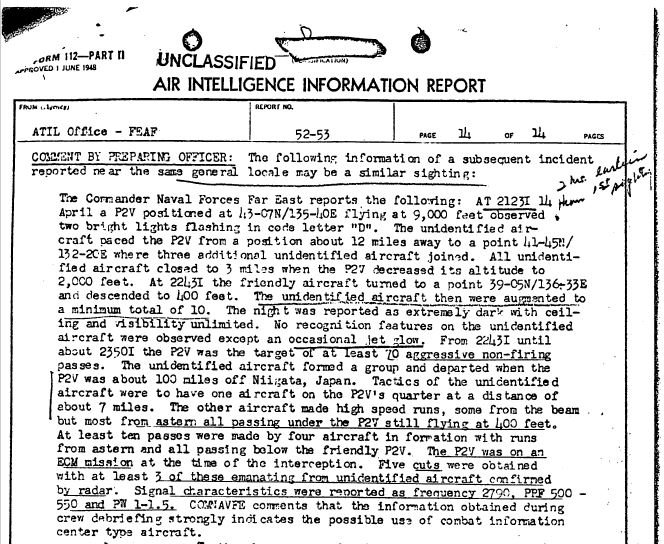
At 2123I, a P2V aircraft was at 43:07N; 135:40E, at 9,000 feet when the crew observed two bright lights flashing in code letter 'D.' The unknown aircraft paced the P2V at 12 miles distance to 41:45N; 132:20E, where three more unknown aircraft appeared. The P2V descended to 2,000 feet and the aircraft closed to three miles.


At 2243I at 39:05N; 136:33E, the P2V descended to 400 feet. There were now ten unknown aircraft present. From 2243 to 2350, the P2V 'was the target of at least 70 aggressive non-firing passes.' The unknown aircraft made high speed passes, some from the beam, but most from the stern 'all passing under the P2V still flying at 400 feet...At least two passes were made by four aircraft. The unknown aircraft departed as a group when the P2V was about 100 miles off Niigata, Japan.


What were some of the R-V cases which McDonald himself, considered significant?

1. 'The 1957 Gulf Coast RB-47 Incident.' (Flying Saucer Review 1970. 16(3):2-6.)

2. 'UFOs Over Lakenheath in 1956.' (Flying Saucer Review 1970. 16(2):9-17.)

3. Kincheloe AFB, Michigan. Sep 11-12, 1967.

4. US Naval Air Station North Island, San Diego, California. Oct 14, 1957.

5. Gulf of Mexico B-29 Dec 6, 1952. (Source: 3-5. 'Meteorological Factors in Unidentified radar Returns.' Proceedings 14th Radar Meteorology Conference. Nov 17-20 1970. Tucson Arizona.)


In conclusion

I have identified sources, where some of McDonald's R-V cases reside, but it would appear, that no-one today, other than the University of Arizona's Special McDonald's collection, has a copy of all of these R-V cases, in one place.

Academic funding for UAP research

Two pieces of funding to support academic research into UAP, have been revealed in recent times. The first is a donation to the University o...