STAGE ONE REPORT ON THE 2nd
APRIL 1966, MELBOURNE, VICTORIA, AUSTRALIA, OBSERVATION AND PHOTOGRAPH OF JAMES
JOHNSON KIBEL
Compiled by Keith
Basterfield and Paul Dean.
1. Introduction
1.1 The
purpose of this stage one report on the 2nd April 1966, visual and photographic
observation, by James Johnson Kibel, of Melbourne, Victoria, Australia, is to bring
together as much of the primary and secondary material as possible. We have located James Kibel, and provided him with an opportunity to read this report before it was published. He advised that he has no problems with us using his real name.
1.2 There
is much about this observation and photograph, out there on the Internet.
However, most is second, third hand or worse. We wished to locate and make
available as much first and second hand material as possible, to allow readers
to decide for themselves what the observation and photograph tells us about the
UFO phenomenon.
2. Primary sources from 1966
2.1 There are several primary sources of
information about this observation and photograph. We define a primary source
as one which directly involved the witnesses themselves.
- A Polaroid photograph, taken on 2 April 1966
- A National Investigations Committee on Aerial Phenomena (NICAP) report form completed, and dated 19 April 1966 by James Kibel
- An interview of James Kibel, undertaken by Professor James E McDonald on the 28 June 1967 in Melbourne
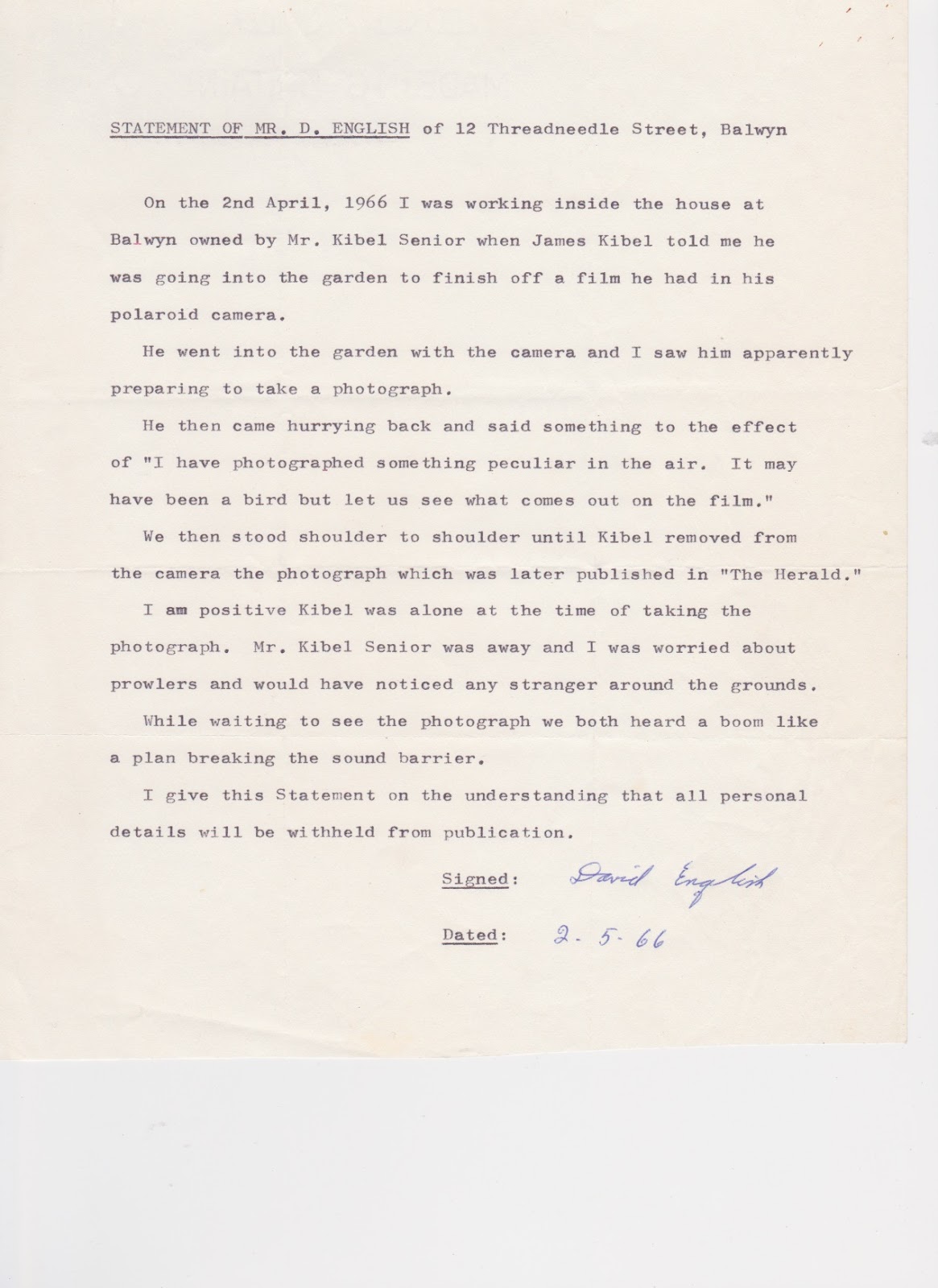
A statement by Mr David English who was a witness to the developing of the Polaroid photograph, dated 2 May 1966
A sketch of house and garden drawn by James Kibel in April 1966.
3. Secondary sources
3.1 There are a number of other sources of
information about the event, dated 1966. These are not items directly generated
by the witnesses.
3.2 We provide here the text of those
articles.
4. The primary
sources
4.1 A colour
Polaroid photograph
Black and white copies of the colour
Polaroid photograph feature in both the VFSRS AFSR, and the APRO Bulletin.
4.2 NICAP report
form
The following is the text from this form:
1. Name: James Kibel.
Address: 22 Austin Street, Balwyn, E8,
Melbounre, Victoria, Australia.
Place of employment: Melbourne, Vic.
Occupation: Company director.
Education: Primary and secondary school
and technical school.
Special training: Administration, civil
defence.
Military service: Radiation expert,
Headquarters instructor, civil defence (also see letters).
Telephone: 802280.
2. Date of observation: April 2nd
1966.
Time 2.21pm EST.
3. Locality of observation: Garden of
house, Balwyn.
4. How long did you see the object? 6 seconds
approx..
5. Weather: Bright daylight. Very light
cloud.
6. Position of sun or moon: Sun above and
behind the object.
East to west at first – towards sun –temp
about 81 deg F.
7. N/a
8. More than I object? No.
9. Describe object:
Was solid – slowly turning - noticed
turning when object faced its flat side towards me.
10. Was the object brighter than the
background of the sky?
Good contrast.
11. N/a.
 |
| NICAP form page 1 |
12. Did the object:
a. Appear to stand still at any time: Yes,
very briefly after turning on edge.
b. Suddenly speed up and rush away: Yes, after
turning on edge, turning flat side towards me. It moved off very rapidly in a
northerly direction.
c. Break up into parts or explode: No.
d. Give off smoke: No.
e. Leave any visible trail: No.
f. Drop anything: No.
g. Change brightness: No only when
reflecting sun.
h. Change shape: No.
i. Change colour: No.
13, Did the object at any time pass in
front of, or behind of anything?
When moving off to north was lost from
view from garden.
14. Was there any wind? Yes.
Direction and speed: North westerly gutsy
about 20-25 mph.
15. Did you observe the object through
optical instrument?
No. Did not even see it through view
finder.
16. Did the object have any sound?
Not at first, but after moving off to the
north a loud boom was heard by me and witness.
17. Please tick if the object was:
a. Fuzzy or blurred.
b. Like a bright star.
c. Sharply outlined: Appeared well
outlined against sky.
Handwritten on the form:
Camera used – Polaroid Model 800 – Quite
old.
Set on infinity Ev II on ev scale.
Using Polacolour film type 48 – 2 years
out of date.
18. Was the object:
a. Self-luminous.
b. Dull finish.
c. Reflecting? Very – seemed to be made of
polished metal.
19. Did the object rise and fall while in
motion?
At first drifted down in level flight.
Then tipped on edge. At which time I took photograph – it appeared to falter
when turn 90 deg on its axis to face flat surface towards me- at this time I
saw rotation of object – it then moved off to north – very fast.
 |
| NICAP report form page 2 |
20. Apparent size:
½” to 1” at arm’s length.
21. How did you happen to notice the
object?
Very bright reflection off sun on garden
made me look up.
22. Where were you and what were you
doing?
In garden intending to take photographs of
house and garden.
23. How did the object disappear from
view?
Very quickly to north – could not see due
to trees etc.
24. Compare the speed of object with
aircraft.
Much slower than aircraft at first then
much faster than aircraft when moving off to north.
25. Any aircraft in area?
A Department of Civil Aviation aircraft
flown over 10 minutes later.
26. Please estimate the distance of the
object.
About 350 -400 feet from me and about 150
feet up.
27. Elevation.
(Sketch drawn)
28. Names and addresses of witnesses:
Witness does not want to be involved so
cannot give name at this time.
29. Draw map.
30. Airport, military items in area?
Yes. Airforce Radio School about ¾ of a
mile away.
31. Previous UFOs?
Once during 1957 from positon A see above
– 3 witnesses at that time.
32. Enclose photos etc.
33. Were you interviewed by Air Force
investigators?
No, not yet.
Federal, state, county or local officials.
No.
One newspaper. Peter Norris of VFSRS
looked at picture.
Were you asked not to reveal or discuss
incident? No, not yet.
34. Can we use your name?
Please do not use my name at this time.
Dated 19 April 1966 Signed James Kibel.
4.3 Interview
between Kibel and the late Professor James E McDonald
We have been fortunate enough to secure a
copy of the audio recording of that interview, from the James E McDonald
collection, held at the University of Arizona in the USA.
The following is a transcript prepared by
Keith Basterfield and Paul Dean. It should be noted that where there is a (…)
symbol the words are not decipherable, due to back ground noise such as a dog
barking.
The interview:
Kibel. I don’t want my name to be used.
McDonald. This is Wednesday June 28th
of 1967, its about 4.20 in the afternoon. We are in a Melbourne suburb, and
going over some of the details of the Balwyn photograph, with the person in
Melbourne who took the photograph. His name will not be identified here, but we
are going over some of the circumstances of the photograph. So, I don’t recall
the date, why don’t you, (…) I’ll make some notes here too.
K. The only thing is, I haven’t got the
file with me at the moment with the report that I wrote out in it, so
Mc. You don’t know the date off hand?
K. April the second 1966, I’m pretty sure
of that. 21 minutes past two pm.
Mc. I think have the date here (…) …if I’m
not mistaken. Balwyn April 2nd 1966.
(There is then a discussion of the
pronunciation of the name “Balwyn.”)
Mc. April 22nd, 2nd
1966 at 1421. Balwyn is a Melbourne
K. Suburb yes suburb of Melbourne.
M. Which side?
K. Eastern suburb.
Mc. This was at your mother’s home?
K. Yes 1 Palm Grove Deepdene. (…)
(Discussion about whether or not to record
the address. Kibel spells out how the address is spelt.)
Mc. What were you doing, oh lets, let me
get the camera type first.
K. Camera was a Polaroid 800. I can show you the camera I think it’s called
an 800 it’s an old, old camera.
Mc. And you had color film, do you
remember the speed rating?
K. Yes, I had an old Polaroid colour film
in it. I have got the details of it to show you (…) which I was only going to
use up in the garden there. The reason I was at the house at the time, was that
my parents were overseas and I was having the kitchen renovated while they were
away so I was down there supervising the alterations. There were a number of
men working on the house.
Mc. Ok. And you were out in the garden?
K. Yes I went into the garden just to
finish the film.
Mc. Flowers or something?
K. Yes. Two pictures left in the camera.
One I took which was, completely unsuccessful because due to the extreme age of
the film in the camera I think it had slowed right down. I increased the ev
setting to improve on it. This is when this thing turned up. Obviously I did the right thing, because that one came
out.
Mc. Ok. You had taken some, of the film.
You had exposed some, anything that came out prior to this?
K. No I was taking photographs down in the
garden.
Mc. Had you taken anything? Had you
produced any films prior to this one?
K. Only a very badly exposed one of the
flowers. Taken it and threw it away.
Mc. And that’s why you adjusted the speed?
Mc. How did you first notice it?
K. Well the first thing, which would be
almost due south, in part of the garden, at the western side of the house and,
I noticed a terrific flash on the garden as if, similar to the flash produced
by a mirror in a heliograph type flash on the ground. It was, sort of,
enveloped half the garden, and gave me a fright.
Mc. Quite an area then?
K. Oh yes. I jumped. I turned my head to
the left, which would be facing east then, and saw this object descending,
apparently almost vertically in a sort of bouncing motion, like a, rather like
a yo-yo. Of course, I had the camera in my hand and I spun around and the first
thing I thought of, was I must get a photograph of this. I brought the camera
up, and as I brought the camera up, the thing pivoted up, on its edge, and I
took the photograph and then dropped the camera down
Mc. Let me get, back up. It came in with
the stalk down as I recall.
K. Yes right. That flat area on it was
Mc. (…) to help to get the orientation.
K. Towards the ground yes.
Mc. Stalk down. Picking up the mushroom
analogy.
K. Yes.
Mc. Stalk down, and it was bouncing along.
K. It was bouncing down, it was dropping I
would think, vertically downwards although it may
have been approaching me. I’m not sure, but it was descending in a bouncing
fashion. It was, sort of behaving like a yo-yo. It was dropping down and then
returning through about quarter of the distance it had dropped.
Mc. (…)
Mc. You were conscious of advance at the
same time, during?
K. No, no. Apparently not. It looked about
the same size.
Mc. Ok. And no noise?
K. No, no noise at all. Just the noise of
the wind which was blowing fairly hard, it was a northerly breeze, very warm
day it was about 80 degrees.
Mc. And. A good breeze, northerly breeze.
K. Yes. Northerly.
Mc. Northerly. And scattered cirrus.
K. Mm. Yes.
Mc. ….. Is that the case, reading it off
the photo? Ok and what do you estimate, what was your, what has been your estimate
of the range to the location on the , over, which it was apparently coming
down, miles, 100 yards, feet?
K. Its vertical range from the ground,
sort of underneath it?
Mc. Plan view only at the moment.
K. I thought it was, I don’t know. A
hundred, it could have been two or three hundred feet, feet this is what struck
me.
Mc. I don’t mean the distance up. I was
trying to get the.
K. Oh, from me.
Mc. You were in the garden and if in fact
it was not approaching you, which is your impression, it was yo-yoing down on
the spot on the map, your somewhere else on the map, and we’re trying to get
this distance at the moment. Do you think it was hundreds of yards, hundreds of
feet, tens of feet?
K. I would say it was 2 or 300 yards away.
Mc. 200 to 300 hundred yards, in other
words.
K. No, it is very hard to say. I couldn’t
say exactly how far it was from me, but I had the impressions, its actual
distance from me was about 300 feet. That’s what I thought. I remember at the
time, I thought it was 3, 400 feet away.
Mc. While it was doing the yo-yoing or? Or later on?
K. Yes, because it stopped. One of the last
yo-yos. It just stopped as if a switch had been turned off. It sort of flipped
up on its edge.
Mc. One of the yo–yo descents?
K. So that one of 2 or 300 yards wouldn’t
be correct.
Mc. Apparently not, if you thought it was.
K. No. I thought it was feet.
Mc. Cut it by a factor of three. It
stopped. ( … ) It stopped and
immediately.
K. It turned up on its edge, as if it had
a hinge on the, let’s say, facing it in the position with the stalk towards the
ground.
Mc. What could we use?
K. On the left hand edge it appeared to
have a hinge, swung up.
(Apparently they try and use an ash tray
to illustrate the movement.)
Mc. Well, this isn’t too bad. We can
understand that to be the stalk, if somewhat smaller, and that should be the
stalk and we can (…) be sure that isn’t full of ash, is it?
K. It sort of, basically came down like
that, you know, and then it just went, just like that.
Mc. On the lower, flipped on the lower,
and the stalk was then towards pointing towards?
K. Yes. Pointing south.
Mc. Stalk to south. And bell to north?
K. Yes
Mc. And then did it hover there for a
moment?
K. Just for a fraction of a, I would say
about half a second, stayed in that position.
Mc. Without any other motion?
K. No. It wasn’t vibrating or anything. It
was just dead still there for that half a second. Then it turned with the stalk
towards me. It pivoted so the stalk appeared towards me.
(They then discuss ordering drinks)
K. These were 90 degree movements around
the.
Mc. Vertical axis. 90 degrees, with stalk
towards you?
K. Yes.
Mc. And then?
K. By this time I had the camera down
again about waist level. I was peering at it because I knew there was no point
in worrying about the camera any more.
Mc. Had you shot, had you made, when did
you shoot?
K. I took the picture when it was in that
sort of vertical position.
Mc. Stalk to south.
K. South, yes.
Mc. Looking east?
K. That’s when I took the picture and
nearly brained myself with the camera. I should have brought my file with the
actual report I wrote out in it. But still, I can still remember.
Mc. Then you shot it here?
K. Yes.
Mc. It turned the axis?
K. Then it swung.
Mc. Stalk towards you?
K. Yes.
Mc. Stalk towards the west?
K. Yes. That’s right.
Mc. And you dropped the camera.
K. I dropped the camera by this time
because.
Mc. You lowered it?
K. Yes. Down to waist level.
Mc. Because what?
K. Well, I realized that I couldn’t take
another photograph. The think takes 60 seconds to come out and I had to draw the
film out of the camera before it would start to develop. So I spent, I well
thought I’m going to keep my eye on this.
Mc. This is a slow process, 60, (…) got
three shots in 45 seconds (Reference to Heflin photos?)
K. I think he was using the type of camera
where you would draw the actual picture from the camera. With this one you had
to open the door on the back and peel it out, a really old one.
Mc. So (…)
K. Then, it appeared to me to be turning
slowly because of sort of flares of light were going across the bottom of it,
did give a sensation it was rolling over towards the north.
Mc. Along its stalk axis, rolling along the
axis of revolution?
K. Yes. Rolling in the direction it had
turned.
Mc. Is this an impression, that you are
not positive of?
K. No I can’t. To be quite honest I can’t
be absolutely positive. I noticed the changes of light on the base of it, but
that could have been due to it altering position rather than turning.
Mc. Ok. It’s a very shiny object.
K. Oh, it was. Very.
Mc. Hard, been hard to discern.
K. But you know how on a flat object. The
lights you get the sort of triangular, sort of flare across the bottom of it,
it sort of had these flares, a couple of them, shot across the bottom of it as
it turned towards me.
Mc. Were you conscious at the time of any
of this pink reflection of that?
K. No, not until I looked at the photos. I
didn’t; I wasn’t conscious of this at all.
Mc. It looked metallic and shiny to your
eye?
K. Very, very shiny. Just like a mirror. I
noticed its brilliance you know. It was reflecting the Sun in sort of flashes.
Very, very brilliant.
(More discussion on drinks.)
Mc. Now it is moving, rolling. What
direction?
K. It appeared to be rolling towards the
north.
Mc. Rolling to the north.
K. Indicating it was turning. Then it
seemed to lose a little bit, a small amount of altitude, it seemed to drop, 15
or 20 feet, this is what it apparently did. When it reached the bottom of this
drop, it jerked violently upwards 30 or 40 feet I would say and at the same
time accelerated to what I can only describe as an unbelievable speed as it
disappeared just almost instantaneously out of sight behind the trees.
Mc. Now it kept to the bottom, jerked
violently.
K. It jerked violently.
Mc. 30 or 40 feet and it kept going.
K. No, on an angle, and disappeared in the
distance.
Mc. Is this two separate phases of motion,
you could follow it this way and then (…)
K. It dropped like that and then just as
it came to the bottom it jerked up, and curved over and disappeared. It didn’t
apparently keep this sort of climbing motion (…) This sort of seemed to be a
hop in other words.
Mc. In apparently a straight line and then
what?
K. It was sort of that motion, it was a
definite hop.
Mc. It then went into a curve, is that it?
K. Yes, sort of. As it disappeared from
sight it was sort of curving, apparently curving away, away from me. I lost
sight of it when it was about there, sort of
Mc. And it jumped up at an angle of what,
maybe 30- degrees (…)
K. Yes, I’d say about 30 degrees.
Mc. Did it stop at the end of that jump,
was there a distinct break in the motion?
K. No.
Mc. Or did it (…) direction?
K. When it came to the bottom, it abruptly
changed direction but there was no apparent stopping in between it. It sort of
went like that.
Mc. Then what separates the end of the
jerk from the beginning of the next stage (…)
K. It sort of jerked and curved over.
Mc. Curved over and accelerated.
K. Yes, and disappeared without a sound.
Mc. How many seconds do you think it took
to, you didn’t get out of sight in open sky, it went.
K. I couldn’t see it. I jumped to see if I
could see it but it had gone. I couldn’t see it.
Mc. It disappeared behind trees?
K. Yes. It disappeared out of view. I then
took off around the house because I knew one of the workmen had been working on
the other end of the house, sawing wood. And I was convinced that if he had been
looking up he would have seen it, because I thought it must be over about where
he was.
Mc. Yes.
So, on the way I was running around the
house. I pulled the film out of the camera which started the processing
working. By the time I got to him and asked if he had seen anything, and he
said no he hadn’t. Because, obviously he couldn’t have seen anything, he was
bending over his work and the thing didn’t make any sound. So I then withdrew
the picture from the camera. He watched me take the picture from the camera,
and he was very startled. Evidently he said that while I was in the garden at
the other end, he had, while he was looking up he had seen me in the garden
during the period of the exposure, but he hadn’t taken much notice. He just
noticed I was in the garden at the time but unfortunately he didn’t look up.
I think Peter took a statement from him. I
gave him his name and address and I think Peter went round and took a
statement.
Mc.
You don’t know his name at the moment?
K. Mr D English, his name was.
Mc. Mr D English He’s a carpenter?
K. Yes. He is tradesman.
Mc. (…)
K. I hope Peter got a statement. How long
he actually had me in view, I’m not quite sure. But you can check that from the
statement. I didn’t sort of follow it up.
Mc. So he saw you pull the film out?
K. Yes.
Mc. You have a witness to the appearance
of the photo. (…) Next best to witness the object. He was startled to look, to
see the object?
K. Oh very. When he saw the picture he was very taken
aback.
Mc. Ok. Now did you then, is there more,
you never saw it again?
K. No.
Mc. Ok. Now did you happen to enquire
around the neighbourhood?
K. Yes. I asked, asked the people next
door, but they hadn’t seen anything. One of them had been outside, sweeping,
sweeping the garden, but they hadn’t looked up, they hadn’t seen it.
Mc. You never heard that anyone else had
seen it.
K. No I hadn’t heard anything else.
Mc. Did that surprise, are you among those
witnesses who are thereby surprised, or do you understand that in terms of a
mode of activity of people in that neighbourhood.
K. Well, it’s quite an exclusive
residential area that’s mainly populated by older people. It’s not really
unusual for people not to see these things I’d say but (…) but the other thing
is too, that there could have been others that saw it but just wouldn’t say
anything about it. I think this is a good possibility. I’d feel quite certain
someone else must have seen it, but whether they said anything about it is
another thing.
Mc. So, times, motions, colours. Did, did
Paul ever mention to you a feature of the shadow on the object that. Didn’t
bother me, it’s odd I thought. Did he ever discuss with you?
K No, I have never discussed it with him.
Mc. He had large prints that you.
K. Yes I have got some as well.
Mc. And see it on a magnifier on this but
it’s just that the, let me refresh my memory. Here we nominally have a surface
of revolution.
K. Yes, yes, I know what you mean.
Mc. And we have views of the upper and
lower edges, which if it is a surface of revolution (…) define the shape.
K. Yes, that’s right.
Mc. Then the question arises, the
shadowing on it (…) in fact in the middle of the shadow, sketch this here, from
this, shadow, has a cusp, a (…) cusp which I am going to exaggerate.
K. yes I know, you can see that on my (…)
Mc. I wonder, if it is a surface of
revolution, then why should the shadow, should be the shadowing not be some
kind of continuous curve. Do you rationalize that, anyway or thought about it.
What could have produced that cusp? A notch?
K. Frankly I don’t know. Because, there
could be; on the enlargement you could probably see it better. There seems to
be reversed curves and all manner of things up near the top of this thing,
which I call the top, that’s the part with the point on it. And arr, such a
curve round the lower edge, the edge nearest the stalk could possibly produce
that (…) effect.
Mc. If there, if there is a, an
irregularity on the surface, and if it is a surface of revolution then the
upper and lower limbs must show that. This end and this end.
K. I see yes.
Mc. It may not be a surface of revolution,
but that poses a question. Did you think at any time that it was anything other
than a revolute?
K. No I didn’t. (...)
Mc. Left with the impression.
K. I was left with the impression that
that was a (…)
Mc. (…) easier to ponder if we had a blown
up version.
K. I should have brought that with me. I can
perhaps mm. We can have a look at that next week.
Mc. We probably should. I don’t have any
bright ideas as to anything that would be in the neighborhood that would do it.
But that may be. This may be a highly distorted curved mirror type reflection of a building, and it
may in fact be identifiable as a building. We should give that some thought…… Sit there and think about the
angles. Do you have anything in the way of surveying gear that we can
reconstruct the (…) or already been there (…)
K. We already measured it all up, I’ve got
the details of that, anyway.
Mc. We might see if we can think back to
what, what object is behind you. Would. Presumably. It looks like it is above
the mid-section.
K. Yes.
Mc. of it. That’s kind of bad, because
your line of sight, then would, be reflected up into the sky. So it’s got to be
some very tall building if it’s going to do that. It’s probably not (…)
K. (…) because there’s only houses sort of
on this side, there’s a fence, sort of there, then there’s houses, a house, a
big house.
Mc. Not particularly tall.
K. No. would it be. If it had been over
the house further that way. Could it possibly have been a reflection of a tree
here, although it couldn’t be because it would mean.
Mc. Well, no, because if it’s a revolute,
and this is above the mid-section, then and it appears to be, then the specular
reflection is of the sky up here.
K. That’s right yes.
Mc. It really does look like its well
above the middle section.
K. I’m very puzzled with those reflections
because I couldn’t, also couldn’t see how it could be the reflection of the
roof of the house. I just couldn’t see this. It’s this, this interpretation
which has been put on it by Peter and his society. I don’t think there’s
enough, you can’t get sort of enough information from this photograph to
indicate what is being reflected, you know.
Mc. You are looking here, you are looking to
the east, right?
K. That’s right, almost due east.
Mc. Sun in the north?
K. The Sun was behind me. Ummm. It
was just, just above and behind. I think Dr Berson had the, the altitude and
everything of the Sun.
Mc. Well, when we have a large photo, then
standing out there, let’s try to go over that again. That’s an interesting
point. It may simply be that when you look more carefully at all the angles involved that it I simply the
difference between the Sun illuminated part, and the non-illuminated part. It
may be that. Is there any possibility of getting print of that? Are there black
and white. Do you have any black and white?
K. You haven’t got any prints, have you?
Mc. No, no. I do have prints like in the
(…)
K. Sure, I’ll.
Mc. I don’t want to ask you to go to any
bother.
K. No. I’ve got some prints I think, you
can have the spare ones I’ve got, the copies of that. Now you have seen the
original you know they’re copies too.
Mc. Yes.
K. So, I can let you have those. Yes,
sure.
Mc. If I can get one glossy. Ok. So I
guess we’ve gone over the whole incident, just once here, and (…) relevant
things we’ve covered but still we. Is there anything else you can think of, at
the moment that needs to be remarked?
K. Not really, apart from the fact I felt
I was very lucky. I gave myself a very sore nose hitting it with the camera.
Mc. (…)
K. I nearly knocked myself out. Yes.
That’s about all really. I can’t add anything else. I have my own opinions
about what I saw.
Mc. What are those? Are you willing to (…)
K. From a, I had the impression. This was
after thinking about the earlier sightings I had which were nothing really
conclusive could be deduced from what I had seen and what the witnesses
involved with the earlier sightings had seen, because the object seen in these
instances were far away although behaved in UFO fashion. In other words, there
was nothing you could really discern of the object and this one was the first
UFO I had seen really closely, and I’ve got a good idea, a good knowledge of
engineered, engineering generally and it struck me as something that had been
manufactured of metal, that appeared to be metal, because it was extremely
shiny, looked very much like stainless steel to me, that was the impression I
get. It had the same sort of luster as stainless steel. And it just impressed
me as something that had definitely been contrived.
Mc. Not a plasma.
K. That’s for sure. There was a definite
deliberation in this, and, the way it moved left no doubt in my mind at all, that something was
manipulating its movements. There were. It was deliberate, and it was
definitely mechanical, the way it swung around and did these things, although
it didn’t agree with any aeronautical behavior that we would, that’s common
today. Its, was definitely movement of deliberation, something manipulating,
something, that is what it appeared to me.”
End of transcript.
4.4 Statement of
Mr David English
This was dated 2 May 1966 and signed David
English.
“On the 2nd April, 1966 I was
working inside the house at Balwyn owned by Mr Kibel senior when James Kibel
told me he was going into the garden to finish off a film he had in his
Polaroid camera.
He went into the garden with the camera
and I saw him apparently preparing to take a photograph.
He then came hurrying back and said
something to the effect of “I have photographed something peculiar in the air.
It may have been a bird but let us see what comes out on the film.”
He then stood shoulder to shoulder until
Kibel removed from the camera the photograph which was later published in “The
Herald.”
I am positive Kibel was alone at the time
of taking the photograph. Mr Kibel Senior was away and I was worried about
prowlers and would have noticed any strangers around the grounds.
While waiting to see the photograph, we
both heard a boom like a plane breaking the sound barrier.
I gave this statement on the understanding
that all personal details will be withheld from publication.”
4.5 Sketch of house and garden drawn by Kibel
5. Secondary
sources from 1966
5.1. “Herald”
Melbourne newspaper dated 12 April 1966
“Blimey! Now it’s a flying mushroom…
All in a Balwyn garden.
Mr Peter Norris, president of the
Victorian Flying Saucer Research Society, today released a photograph of an
“unidentified flying object” taken from the garden of a Balwyn home.
Mr Norris said that the object was snapped
by a society member at his home at 2.21pm on Saturday April 2.
The member, whose name is not available,
because of business reasons, said today he was using color film in a polaroid
camera.
“It was a warm, clear day and suddenly the
whole garden became lit up. It was like a reflection from some huge mirror
being shone on the garden” he said.
“I looked up and saw an object, bright and
shining, coming towards me. It would have been between 20ft and 25ft in
diameter and was about 150ft up in the air.
“It seemed to float down towards me. It
resembled a big mushroom with the stalk pointing towards the earth.
Shot off:
“Then it spun through an 180 degree angle
on its vertical axis to take up the position in which I photographed it.
“Then it turned slowly through another 180
degrees on its horizontal axis to bring the stalk part facing me.
“From an almost stationary position it
took off northwards at terrific speed, accelerating to what seemed to be hundreds
of miles an hour in seconds.
“I ran and got a carpenter who was working
on the house. Seconds after it took off we heard a boom, similar to the sound
jets make when going through the sound barrier.”
Then man said he copied the print from his
polaroid camera and enlarged it to get the photograph shown here.
Mr Norris said the research society would
fully investigate the sighting.
“I know the man personally and I am
certain this is not in any way a hoax” he said.”
5.2. APRO
Bulletin May-Jun 1966 issue, p.1
 |
| Note the reversed image is used here |
“Best Photo Yet – In Australia
Peter Norris has forwarded a print of the
clear colored photograph taken by a prominent Melbourne businessman on the 2nd
of April. Although the photographer asks anonymity, he is a member of the VFSRS
and is known and vouched for by Mr Norris.
2.20pm on the 2nd, the man was
in his garden using up the remainder of the film in his Polaroid color camera.
Suddenly, a bright reflection caught his eye, and he looked up and saw a
bell-shaped object hovering, on its side, over the house. The man snapped the
photo, whereupon the object accelerated at great speed and took off in a
northerly direction. He estimated the object was about 20 to 25 feet in
diameter, and at about 150 feet altitude.
If at all possible, the photo will be
included with this article [KB – it was.] In the black and white print, the
bottom appears black but in actuality, in the color photo, it is pink,
reflecting the color of the roof over which the object hovered.”
5.3. Australian
Flying Saucer Review (Vic edition) July 1966, front cover & p.2
“VFSRS member snaps a UFO
A Polaroid colour photograph of a UFO is
now under investigation by the VFSRS.
The photograph was obtained in Balwyn, Victoria
at 2.02pm on Saturday, April 2nd by a society member who has
requested that his name be withheld for business reasons.
The member’s description of the incident
is as follows;
“It was a warm, clear day, and suddenly
the whole garden became lit up. It was like a reflection from huge mirror being
shone on the garden.
I looked up and saw an object bright and
shiny coming towards me. It would have been 20 feet to 25 feet in diameter and
was about 120 feet up in the air.
It seemed to float towards me. It
resembled a big mushroom with a stalk pointing towards the earth.
Then it spun through an 180 degree angle
on its vertical axis to take up the position in which I
photographed it.
Then it turned slowly through another 180
degrees on its horizontal axis, to bring the stalk facing me.
From an almost stationary position it shot
off northwards at terrific speed, accelerating to what seemed to be hundreds of
miles an hour in seconds.
I ran and got a carpenter who was working
on the house. Seconds after took off we heard a boom, similar to the sound jets
make when going through the sound barrier.”
One interesting aspect of the photograph
is a shading of pink directly on the bottom part of the UFO. This appears to be
a reflection of the pink tiles of the roof over which the UFO was apparently
passing at the time the photograph was taken.
When details of the photographic experts’
analyses are to hand they will be published in an issue forthcoming.”
5.4. Flying
Saucer Review (UK) July-August 1966 Vol.12. no. 4 pp 3 & 27
“Melbourne man snaps UFO
By Peter Norris, L.L.B.
A member of the Victorian Flying Saucer Research
Society has released a color UFO photograph taken by him in the Melbourne
suburb of Balwyn at 2.121pm on Saturday April 2, 1966.
The member has requested his name and
address be withheld for business reasons, but the writer will call him James
brown for purposes of reference.
Brown is well known in Melbourne UFO
circles. A student of the UFO subject for more than ten years, he holds
qualifications in engineering and is a director of his family’s engineering
company. He is also an instructor of civil defence.
Brown’s report is as follows:
“It was a warm clear day and suddenly the
whole garden became lit up. It was like a reflection from some huge mirror
being shone on the garden. I looked up and saw an object, bright and shiny,
coming towards me. It would have been between 20 feet to 35 feet in diameter
and was about 150 feet up in the air.
It seemed to float down towards me. It
resembled a big mushroom with the stalk pointing towards earth.
Then it spun through a 180-degree angle on
its vertical axis to take up the position in which I photographed it. It then
turned slowly through another 180 degrees on its horizontal axis to bring the stalk part facing me.
From an almost stationary position it shot
off, northerly at terrific speed, accelerating to what seemed to be hundreds of
miles an hour in seconds.
I had run and got a carpenter who was
working on the house. Seconds after it took off we heard a boom similar to the
sound jets make when going through the sound barrier.
The writer subsequently interviewed the
carpenter (name withheld on request) who confirmed Brown’s story. In particular
he emphasized that he had Brown in his sight when the photograph was taken, and
insists Brown was alone all the time.
After photographing the UFO Brown ran back
to the carpenter and they stood shoulder to shoulder waiting for the photograph
to process. When it was taken from the camera, the image of the UFO on the
print was immediately perceived.
Although it is still under analysis by
VFSRS photographic advisers it can be said at this stage that the Brown
photograph has caused considerable head scratching in skeptical circles. After
all, a colour photograph taken on a Polaroid camera is not the easiest of
things to fake.
Not the least interesting aspect of the
photograph is the pinkish colouring which can be discerned on the underneath
part of both the flange and the “stalk” of the UFO, whilst the upper parts of
the surface appears to be of a brightly polished reflective material. Is this a
reflection of the roof and chimney over which the UFO was apparently travelling
when photographed? Can it be established thereby that the UFO must be a large
object at some distance from the camera and not a small artifact tossed into
the air close to the camera? The answers to these questions will be eagerly
awaited.
One other incidental matter arises. RAAF
investigators have been relatively quiet during the recent Victorian flap, but
are known to have investigated at least one of the sightings.
However, despite the considerable national
publicity accorded to the Brown photograph in both press and television mode,
it is a surprising fact that official circles have so far completely ignored
this vital (perhaps definitive) evidence of UFO existence. One can only guess
at the reason, but could it be officialdom is now only interested in the
explainable sighting, those which keep down to a negligible figure the
percentage of “unknown” cases? Only time will tell.”
5.5. APRO Bulletin Sep-Oct 1966 issue, p.1
“The Balwyn Photo
A complete photo analysis of the
photograph of a bell-shaped object hovering over a residential section of Balwyn (Melbourne
suburb), Australia, has arrived at headquarters.
Along with the analysis which proves the
photo authentic (see page 1, May-Jun issue) was the identity of the
photographer, and the office was surprised to find that he is one of our many
Australian members.
Mr X has an extremely important position
in Melbourne,
and it is easy to see why he would hesitate to be identified with a UFO
picture, or incident considering the controversial nature of the subject. The
full story:
Mr X was in his garden of his home when
his attention was attracted by a brilliant flash, as if some huge mirror was
reflecting light to the garden. He looked up and saw the object coming in his
general direction. It appeared to be between 20 and 25 feet in diameter and
about 150 feet altitude. It resembled a big mushroom with its short stalk
pointed earthward.
Mr X ran to get a carpenter who was
working in the house so that he could watch the object also.
The object spun through a 180-degree angle
on its vertical axis ending up with its rim pointing down. Mr X who had been
using up film in his Polaroid color camera snapped the photo and waited from
the timing process before pulling it out. The object then turned slowly through
another 180 degrees on its horizontal axis, whereupon the “stalk” part was
facing Mr X.
From this almost stationary position, the
object shot off to the north at great speed. Seconds after it took off the two
men heard a boom, “similar to the sound jets make when going through the sound
barrier.”
Peter Norris, APRO’s Australian
representative interviewed both Mr X and the carpenter (who also wished anonymity.”
The carpenter emphasized that he had Mr X
in sight when the photograph was taken and that Mr X was alone all the time.
The two stood shoulder to shoulder waiting for the photograph to process.”
5.6. December
1966 Volume 6, AFSRS (Victorian edition) pp11-12
 |
| Page 1 of the analysis |
“Report on UFO photographed at Balwyn.
A. Data
1. The Polaroid photograph with chimney
visible in left bottom will be referred to as photo I in what follows. Enlarged
photo showing the UFO only will be referred to as photo II.
2. The UFO was sighted on 2nd
April 1966, and photographed at 14:21 EST on that day.
Focal length of camera at infinity 6 ins.
Distance from point at which photograph
was taken to peak of chimney (see as on photo I): 81 ft.
Height of chimney from ground level to
peak: 26ft 6ins.
Distance of chimney from curb side of
road: 56 ft.
Distance from point at which photograph
was taken to curb side of road: 54feet
(These data were supplied by the
photographer.)
B. Authenticity of the Polaroid
photograph.
The polaroid photograph and its enlarged
copies show no sign of multiple exposure, montage or any other tampering. No
statement can be made, on the basis of clarity, or lack thereof (see photo II),
about movement of the object in the sky, because immovable objects in phot I show
signs of movement, ie the picture gives evidence of camera movement.
C. Evaluation of height and size of object
in the sky.
1. Data deduced directly from phot I:-
Large (apparent) diameter of UFO: 7mm.
Small diameter: 4mm.
Width of chimney: 4.9mm corresponding to
an actual width of 1 foot 6 inches.
2. Calculated from the data in A2: -
Distance from sub point of chimney at
ground level to camera: 76ft 6 ins.
3. Evaluation from attached serial
photographs and data in A.2 and C.1, 2: -
Azimuth of line projected to curbside of
property
a=121 deg (clockwise from due
north)
Azimuth of vertical plane
through camera and chimney top
a=121 deg 41 mins (see the
diagram)
Probable error of latter
azimuth +/-2 deg.
The ground projection of the
cone in which the UFO is located is shown as two red lines in the serial
photographs.
4. Elevation angle of UFO: 28
deg 36mins. This has been calculated from the true height of the chimney top,
its apparent position in photo I, the relative apparent height of the UFO above
the chimney top, and the horizontal distance between sub point of chimney at
ground level to camera, ie 76’ 6” (see C.2 above.)
5. On the basis of item C.4 the
height of the UFO could be determined for an assumed horizontal distance of its
sub point from the camera. Various heights corresponding to various assumed
distances are listed in the 2nd column of the table.
Horizontal assumed distance
|
Height (feet)
|
Calculated large diameter
(metres)
|
Small diameter
|
200
|
109
|
3.2
|
1.8
|
400
|
218
|
6.4
|
3.6
|
680
|
371
|
10.9
|
6.2
|
800
|
436
|
12.8
|
7.3
|
1000
|
545
|
16.0
|
9.1
|
6. The large and small (actual) diameters
of the object could be determined from the assumed distances, the focal length
of the camera (see A.2), the apparent diameters on photo I (see C.1), and the
angle of elevation (see C.4). Diameters are given in the third and fourth
column of the table.
7. At the time the photograph was taken,
the UFO appeared to have been near the school and or even closer, not further
than the southern portion of the public park southeast 400 feet. Assuming a
circular cross section, the circumference of the UFO at its widest cross
section would have been at least 10m but possibly as large as 35m (33 to 115
feet).
D. Remarks on light reflections from the
surface of the UFO.
“On 2nd April, 1966, the
altitude of the sun at 14hr 21mins was 46deg 45 mins and the azimuth 45 deg
59min west of north when observed from Box Hill. This information was supplied
by D F Marshall, lecturer at the Observatory, Institute of Applied Science of
Victoria.
In the here adopted notation, the azimuth
of the sun was therefore 314deg11mins (clockwise from north) and its elevation
about 18deg higher than that of the UFO. Providing the sun at the instant of
taking the photograph was not obscured by cloud (and from the photograph it
appears that there was sunshine at that instant), it would follow that (1) the
UFO exposed to the camera, ie not at an angle of 90 deg but at an angle of 75
deg in the plane of viewing; (2) that the light came slightly from above, relative
to viewing from the camera position.
The effect mentioned in item (1) is not
substantiated by any indication of consistent shadows on photos I or II.
Footnote: The names and addresses of the
authors of statements B, C and D may be supplied on request.”
Note: A photograph accompanied the text,
plus a diagram of relative distances and angles.
There is also a version of the
Kibel/McDonald interview, which appeared in 2002, apparently using McDonald’s
hand written notes of the 28 June 1967 interview.
(The following text is taken from the book
“Firestorm: Dr James E McDonald’s Fight For UFO Science” published in 2002 by
Wild Flower press, Columbus, NC. ISBN 0-9-26524-58-5. Kibel was interviewed in
mid 1967 by McDonald, when McDonald was in Australia.
“On April 2, 1966 James J Kibel was
supervising alterations at his parent’s home in Australia. He decided to use up the
film in his Polaroid 800 camera on the beautiful garden.
The film was so old, the witness told
McDonald, that it was of altered speed. “Kibel tried one shot, which turned out
badly. He adjusted the speed setting.”
Suddenly he noticed a bright flash on the
ground. Although it was full daylight, half of the garden lit up. Startled, he
looked up and saw a peculiar shiny object, descending downward. The top was
shaped like a bell, and a “stalk” projected from the bottom. The object bounced
up and down in “yo-yo” fashion. Kibel had difficulty describing how far the
object descended. “Two hundred to three hundred feet,” he estimated. “It’s
terribly hard to say.”
It was a warm, sunny day with a strong
northerly wind, gusting to 30mph, yet the wind seemingly had no effect on the
object’s bouncing motion. At one of its descents, the object’s bouncing motion
stopped and flipped up on its lower edge. It hovered a half second and Kibel
hastily shot a photo. In his haste and excitement, the camera hiut his nose so
hard that it hurt afterwards.
He lowered his camera, he was unable to
shoot again immediately because the color Polaroid film demanded a 60 second
wait between pictures. McDonald’s journal continues
“Rolling to the north, it then seemed to
lose a bit of altitude, maybe 15-20 ft bottom of drop, it jerked violently
upwards 30-40 feet at an angle 30 degrees to horizontal. Then curved over and
accelerated at very great rate. Disappeared behind trees.
Kibel ran around the house trying to find
other witnesses, pulling the film in the Polaroid to start the developing
process. A worker, Mr D English, was bending down in the yard; he had seen
nothing. Kibel pulled the picture out, startled by the clarity of the photo. He
looked for other witnesses, but could find none. It was an exclusive
neighbourhood where not many people spend time outside, he explained. He told
McDonald that the object, in his opinion, was definitely “manufactured” and
that its motion was “mechanical.” He estimated its size as between 15-25 feet
diameter.
Jim Kibel had seen two other UFOs from
that same garden when he was still living at home. In late afternoon August
1954, at the age of 15, his mother had called him suddenly into the garden to
view a disc which was flipping in the sky, showing alternately a shiny side and
a dull, dark bottom. Its angular size was equal to an Australian ten cent piece
at arm’s length, very much larger than the moon.
Mrs Kibel reported the object to the staff
of a Melbourne newspaper, who ridiculed her, suggesting she’d been drinking too
much!
After a sighting in 1958 which was also
witnesses by his fiancée Jim Kibel reported it to Peter Norris of VUFORS, whom
he knew personally. Remembering his ridicule his mother had sustained, he
didn’t report it to anyone else. McDonald wrote in his journal “All Jim Kibel
knows is that the objects were definitely there.”
6. Source
material
The following material is available:
Primary
|
Format
|
A copy of a colour Polaroid photograph
|
JPEG
|
NICAP report form
|
JPEG
|
Kibel/McDonald interview
|
MP4
|
Statement by David English
|
JPEG
|
Sketch of house and garden by Kibel
|
JPEG
|
|
|
Secondary
|
|
Herald newspaper 12 Apr 1966
|
JPEG
|
APRO Bulletin May/Jun 1966
|
PDF
|
VFSRS Magazine Jul 1966
|
PDF
|
FSR Jul/Aug 1966
|
PDF
|
APRO Bulletin Sep/Oct 1966
|
PDF
|
VFSRS Magazine Dec 1966
|
PDF
|
“Firestorm” book by Druffel
|
PDF
|