Dear readers,
The Bureau of Meteorology forecast for my home city of Melbourne today was for a maximum of 35 degrees Celsius. It is currently sitting on 37.7 degrees. So, with the kids in the swimming pool I have had some time to work on this blog post.
Firstly, a word about my style of writing blog posts. As an academic I write papers for publication in refereed professional journals all the time. So for this blog I'd like to adopt a much lighter tone, sometimes even humorous (my sense of humour is legendary at work and at home.) Above all I aim to provide factual information, and be readable. My initial perspective will be that of someone reactivating a dormant interest (which of course is true.)
As my blog profile states, I enjoy watching science fiction movies. A recent favourite was 'Passengers' - highly recommended as a love story set on an almost 100 year long interstellar trip. On the other (serious) hand I retain an interest in hard science - keeping up with developments in astronomy particularly in the area of the search for extraterrestrial intelligence.
Well today I have started to look around at today's UFOlogy, by reading a number of websites. The current range of views is very broad indeed. In one place I read the views of individuals who believe they are 'star seeds' - part human, part alien. In another place people recount their solid belief in the existence of reptilian creatures who abduct humans. Elsewhere, there are collections of individuals sharing accounts of their nightly sky watches - and the 'UFOs' they regularly see. Buried amongst all this are 'scientific ufologists' providing hard data and analysis.
It's going to take me a while to digest everything on my UFO search 'menu.' I guess I am on the entrée course at the moment.
I'll look to publish a weekly post, probably each Sunday.
Must away, my youngest is hungry from all the pool work out!
Sunday, January 28, 2018


Saturday, January 27, 2018
Pauline Wilson returns
Dear readers,
For those of you who have been reading this blog since its inception and who have a long memory, you may remember me (Pauline Wilson) as the person who started off the blog. After a while I got married, things became very busy and so I handed over the blog to Adelaide researcher Keith Basterfield.
Last month on an impulse I checked on the blog, and was pleasantly surprised to find it still going, with an excellent track record of posts. I then read Keith Basterfield's post advising that he was taking a break from UFO research. I approached him with the thought of writing the occasional post, and he agreed.
I will take some time to acquaint myself with today's UFOlogy, and then start posting. I have a few year's worth of catching up to do!
One new website I have already visited is The Australian UFO Archives - check it out.
For those of you who have been reading this blog since its inception and who have a long memory, you may remember me (Pauline Wilson) as the person who started off the blog. After a while I got married, things became very busy and so I handed over the blog to Adelaide researcher Keith Basterfield.
Last month on an impulse I checked on the blog, and was pleasantly surprised to find it still going, with an excellent track record of posts. I then read Keith Basterfield's post advising that he was taking a break from UFO research. I approached him with the thought of writing the occasional post, and he agreed.
I will take some time to acquaint myself with today's UFOlogy, and then start posting. I have a few year's worth of catching up to do!
One new website I have already visited is The Australian UFO Archives - check it out.
Wednesday, December 20, 2017
The last post...for a while
This blog was initiated by Pauline Wilson, an Adelaide based UFO researcher, in 2009. When Pauline's interests moved on to other things, I took over the blog. Since 2009 there have been 896 posts; some short, and some thousands of words in length. Total hits on the site have exceeded 750.000.
Over my 51 years of interest in the subject, I have taken a number of breaks from my research. My shortest break was six months, and the longest was four years. I find these breaks from research to be very useful. It is too easy to get bogged down with keeping up to date; reading books; blogging one's research; answering questions from people who wish to know what it was that they have just seen in the sky; and keeping across some 45 Australian Face Book pages dedicated to hundreds of well meaning, but in the end, inane discussions on the topic. Enough becomes enough at some stage.
Despite all the current excitement about the formerly secret US Department of Defence Pentagon UFO program, it is time for me to take another break. At the moment I do not know how long the break will be.
I thank all my blog readers for sharing the journey so far.
Before I go, I'd like to recommend a new Australian website, called The Australian UFO Archives. It is only in draft form at the moment but it provides links to a large amount of factual, informative, Australian material. You will find it here.
So, this blog will see no new posts until I return from my 'holiday' from UFO research.
Signing off for now.
Regards,
Keith Basterfield.
Over my 51 years of interest in the subject, I have taken a number of breaks from my research. My shortest break was six months, and the longest was four years. I find these breaks from research to be very useful. It is too easy to get bogged down with keeping up to date; reading books; blogging one's research; answering questions from people who wish to know what it was that they have just seen in the sky; and keeping across some 45 Australian Face Book pages dedicated to hundreds of well meaning, but in the end, inane discussions on the topic. Enough becomes enough at some stage.
Despite all the current excitement about the formerly secret US Department of Defence Pentagon UFO program, it is time for me to take another break. At the moment I do not know how long the break will be.
I thank all my blog readers for sharing the journey so far.
Before I go, I'd like to recommend a new Australian website, called The Australian UFO Archives. It is only in draft form at the moment but it provides links to a large amount of factual, informative, Australian material. You will find it here.
So, this blog will see no new posts until I return from my 'holiday' from UFO research.
Signing off for now.
Regards,
Keith Basterfield.
Tuesday, December 12, 2017
National Archives of Australia - more new UAP files available
Background
Over the years, Australian researchers have found around 150 files in the National Archives of Australia (NAA), dealing with the subject of 'Unusual Aerial Sightings;' 'Flying Saucers'; 'Unidentified Flying Objects' and a variety of other titles. Wherever possible, these files have been digitised by the NAA, upon the payment of a fee by a very small number of Australian researchers, including myself. Today, anyone can go to the NAA website, type in a variety of keywords, and read the files for themselves.
New material
The NAA continues to add new files, about UAP, to their RecordSearch database. Two newly available files were added in October 2017. These are:

1. NAA file series BP990/1, control symbol 5/113/AIR PART 1, barcode 22420284, titled 'Unusual Aerial Sightings.' This file has a date range of 1975-1977. It is a correspondence file, originally created by Headquarters RAAF Amberley in Queensland. The current file status is 'not yet examined.' In order to view the file someone needs to ask the NAA to review the file, then pay them to digitise it.
2. NAA file series BP990/1, control symbol 5/113/AIR PART 2, barcode 22420285, titled 'Unusual Aerial Sightings.' This file has a date range of 1977-1979. It is a correspondence file, originally created by Headquarters RAAF Amberley in Queensland. The current file status is 'not yet examined.' In order to view the file someone needs to ask the NAA to review the file, then pay them to digitise it.
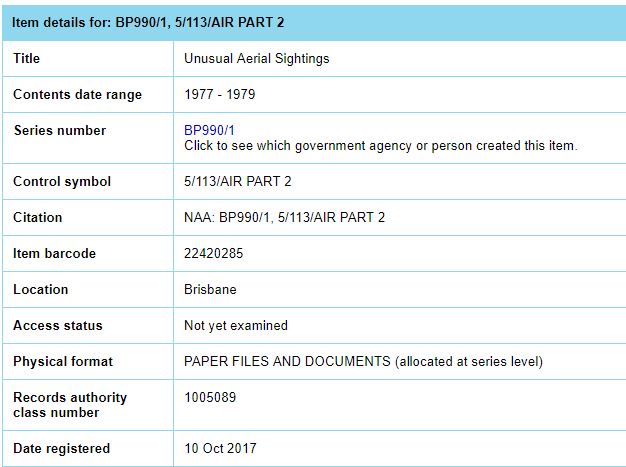
There are two other files whose status is 'Open with exception' which are waiting for someone to pay for them to be digitised. These are:
3. NAA file series A9755, control symbol 9, barcode 3533451, titled 'RAAF No 92 Wing HQ, Edinburgh. Unusual Aerial Sightings. The file's date range is 1992-1994.
4. NAA file series A9755, control symbol 23, barcode 3533584, titled 'RAAF No 82 Bomber Wing, Amberley.' Date range is 1992-1994.
Would any blog readers like to assist us all, by arranging for all these four files to be digitised?
Monday, December 11, 2017
The full version of the Western Australian Police Department UAP file
Background
Between 1951 and 1975, the Police Department of the West Australian government kept a file titled 'Unidentified Flying Objects.' The State Record Office (SRO) of Western Australia posted some 55 pages of this file, to their website around 2015. I came across it and wrote about the contents of the available pages, in a blog post dated 3 July 2015.
It wasn't until 2017 that I noticed that there was a gap in the folio numbering of the 55 available pages. This indicated that there might be other folios of the file available to me. I therefore communicated with the SRO, and indeed the full version of the file contains 156 images. I have just recently purchased a copy of the full file.

My previous post covered folios 1-31 (1951-1954) and folios 123-148 (1970-1975). Thus this current blog will fill in the gaps.
Sightings in this section
26 August 1954. V E, R V and R M H Antonio were in a car near Monument Hill, near Northam at 2.15pm and sighted a grey, oval shaped object in the clear sky. It was stationary.
15 December 1954. At 3am, two men, travelling south by car from Carnarvon to Geraldton saw a light in the ESE sky. Seen for 20 minutes. They reported seeing 'portholes,' along the side of the machine. The object rotated every 30 seconds.
6 March 1957. Three men were travelling west along the Great Eastern Highway at 12.30am when they sighted a very bright green light with a tail, above trees. It rose up, then arced over the trees. Duration 4-5 seconds. It lit up the whole countryside.
3 July 1957. A number of people at the Fibre Queen Asbestos mine, 126 miles SE of Port Hedland, said they saw , at 10pm, a very bright light light up the whole area. Several explosions were then heard.
28 November 1957. At 10.45 am a Mundrabilla station hand heard a loud explosion and saw a cloud of dust and smoke rise into the sky. Soon after that he saw an object , cigar shaped, 030 feet long with no wings. Also at 10.45am two persons some distance away saw the same thing for 5 minutes and thought it was a guided missile. It came in from Eucla, circled at Madura and then went eastwards over Mundrabilla. One person reported that a piece fell off it. There was a blue vapour trail. The RAAF said it was a high flying Canberra jet aircraft.
19 August 1960. At Yallalong Station, 90 miles from Mullewa at 4pm the station owner reported seeing a bright object in the sky, The manager of Curbar Station 160 miles north of Mullewa heard an explosion.
5 August 1961. At 8.20am at Mt Hale Station. The very well known story of multiple objects dropping 'angel hair.' Interviews with some of the observers. For my catalogue and analysis of this and similar 'angel hair' cases, click here.
2 August 1964. At Wittenoom, at 3am , Mr E Rossi was at the Hamersley Ranges, 7 miles south of Wittenoom. He said he saw a 200 foot long object with square windows. It was well lit from within. There were no wings, and no tail. It was travelling at an estimated 200 mph, south to north. It had a tail of flame. It was also seen by three other men. For my cold case review click here.
27 September 1965. At 3.30 am, C K Hallett and M F Holbrook were travelling by truck near the Cane River, 30 miles north of Onslow. Their headlights lit up a cylindrical object. estimated to be 10 feet high and 10 feet in diameter, which took off from the ground at high speed. The two men travelled on in the truck. 10 miles later, they met two other people attending to a broken don truck. After being at this new location for 10 minutes the object appeared again. It swooped down over the two trucks at 200-300 mph. It lit up the surrounding area with a pale green light. The object itself was iridescent green and was lit up all over. It then climbed to a high altitude and disappeared from view.
The Police interviewed Holbrook who added that the object originally travelled roughly east to west, slightly towards them. It crossed the road in front of them and landed, then immediately took off again at high speed. It rose at a 45 degree angle and had descended at a slightly less angle. There was no noise from it. It was pale iridescent green and glowing. It had touched the ground for only a few seconds before rising up again.
On the second viewing at about 4 am, they were facing sought on the bank of the Cane River. The object had been travelling east to west at a low altitude slowly descending as if going to land again. He judged that the object would have been again landing in the same area as on the first occasion. It was the same colour as the first time, but was also emitting a bright white light, sparkling. There were small sparklets falling out of the light. The object passed within an estimated 100 yards of the observers and was silent.
14-15 August 1966. P G Johnston of Kununurra, was driving a bulldozer at night. At 11.54pm on the 14th he watched bright lights come from the south-west, slow down, and stop over a hill at an estimated distance of 1 mile. Then he saw a row of red lights, which appeared to come from behind the first light. There were 6-8 of them. These were not very bright. A few seconds later the red lights went out and the white light grew brighter, in fact too bright to look at.
An area about 12 feet around him lit up like a searchlight. Duration 5 minutes. The bright light went out and four less bright red lights travelled down behind a hill over which they had been stationary. The witness then sat and eat a meal. Then lights appeared from behind the hill and approached to within a 1/4 mile. These hovered 20 foot in the air. A bright white light came on and he could see this clearly. After 3-4 minutes this light went out and he then saw red lights over Kun Air strip.
By starlight he observed a 'flying saucer' type machine. It tilted as it rose so he could see its top. It was silver in colour, 10 feet high, 180 feet long and 80-100 feet wide. Red lights appeared to be portholes on the long side. As it rose, what seemed to be 3-4 points of vapour trailed from the underside. This wandered about the valley for 1 1/2 hours before seeming to land on hills. The lights were there till the first light of dawn on 15 August.
14 February 1967. At around the same time as there was a search for the American Biosatellite believed to have come down over Western Australia, there was a sighting between 7 and 7.30pm of an orange light seen from Bunbury.
30 October 1967. The classic encounter case, near Boyup Brook, between a car and an object, where the driver states that the car instantly decelerated from high speed without any effects, and then accelerated back to high speed in an instant, again with no effect on the driver. For my cold case review click here.
5 May 1968. At 11am there was a report of what appeared to be a flare off Bremer Bay.
25 May 1969. At 2.43pm at Derby, there was a report of a large 'jet' seen NW to WNW.
11 March 1970. AT Christmas Creek Station, 60 miles east of Fitzroy, a cruising object left a vapour tail, as it travelled NW at high speed. The trail was not constant but broken. Smoke followed it to the ground.
Friday, December 8, 2017
2017 UK UAP files release - the 1990 Tornado incident
Background
This is the fifth in a series of posts, drawn from material to be found in the 2017 release of UAP files by the United Kingdom government. As previously mentioned, I am not intending to provide a comprehensive catalogue of the contents of the files, I will leave UK researchers to do that. There are particular aspects of the files, namely certain documents, which have caught my attention, and this is what I am writing about. This post concerns a sighting by the pilot of a RAF Tornado aircraft on 5 November 1990, which at first glance, appears highly intriguing.
The report
 |
| Image courtesy of Google Maps |
'A. 5 Nov 1990
B. One large aeroplane (shape). 5 to 6 white steady lights. 1 blue steady light. Contrails from blue area.
C. In the air. M.C. 6 area. Fl270 YPENBURG
D. Naked eye
E. Heading 100 degrees same alt Fl270
F. Into our 12 o'clock
G. One quarter mile ahead
H. Steady
J. N/k
K. N/k
L. Working Dutch Mill radar
M. [Redacted} 2 AC SQN
N. Nil
O. 2 others from Laarbruch
P. Other info. Aircraft was under Dutch mil control. UFO appeared in our right hand side same level. We were travelling at Mach point 8. It went into our 12 o'clock and accelerated away. Another 2 Tornadoes seen it and possible identified it as a stealth aircraft.'
More detail
On pages 171-174 of the same file, there is an expanded, more easy to understand summary of the sighting. This is included as part of a 'Loose Minute' dated 30 October 2000 to DAS4a1(Sec), responding to D/Sec(AS) 64/3/5 dated 25 Sep 00, titled 'Information on Air Defence matters.'
'3. A Tornado aircraft, probably one of a formation of 3GR1s, (1) was conducting a routine eastbound transit from an airfield in UK to Laarbruch in Germany during the evening of Monday 5 Nov. 19. The aircraft was following a standard TACAN route to join TACAN BLUE 6 at the Flight Information Region (FIR) boundary at a military reporting point known as MC6. Shortly before reaching MC6 control of the aircraft was transferred by the London Military air traffic controller at RAF West Drayton to his counterpart at Dutch Mil Radar in the Netherlands in accordance with standard procedure.
At 1800z, the time the aerial phenomena was observed, the aircraft was leaving UK airspace in the MC6 area at Flight Level 270 (FL270), heading 100 degrees at speed Mach 0.8.
The aircraft was overtaken on the right by an aircraft shaped object, displaying 5/6 steady white and one blue light, at the same altitude which then proceeded to its 12 o'clock position at a range of 440 yards. The probable route of the Tornado is shown on the map at Annex A. It is assumed that the aircraft was still in contact with West Drayton on this second radio and chose to report the incident to UK authorities rather than the Dutch.
4. The incident is unusual in that the aircraft chose to report the incident as an aerial phenomena rather than as an Air Proximity Report (AirProx) to highlight the loss of standard separation between aircraft (at this altitude separation should be 1,000 ft or 5 nautical miles). There is no record of an AirProx report being made on this date in the UK. It is not known, however, whether AirProx of Aerial Phenomena reports were filed with Dutch authorities.
At 1800z on 5 Nov it is dark both on the ground and at FL270. This explains the reference to lights and to 'one large aeroplane (shape)' rather than a more specific description which would be expected of a professional military observer. In these low light conditions, it is generally difficult to judge range and relative motion and it may well be that the aircraft captain had subsequently revised his appreciation of the incident and decided not to take the major step of reporting an air proximity hazard. (2) Significantly, had controllers at West Drayton or Dutch Mil witnessed a loss of standard separation on radar, they would have raised Air Prox Reports in their own right, this was certainly not done at West Drayton.
5. Finally, since the incident clearly involved one or more aircraft departing UK airspace, it is highly improbable that the situation generated any UK Air Defence interest....
8. The 3 Tornados on 5 Nov 00, were not air defence aircraft and were not on an operational mission. There is no evidence that the UK Air Defence radar network either did or did not detect the 'unknown.''
There were two notes which I have labelled as (1) and (2) above:
1. Air Defence Tornado F3s are unlikely to have been flying to Laarbruch.
2. GR's do not carry cameras. 'In addition, the GR1 radar at that time, designed for terrain following, had a very limited air to air capability...'
File DEFE 24/3128/1 page 18 contains a fully unredacted copy of the 6 November 1990 telex/teletype which shows that the reporting pilot was 'SQNLDR Garwood 2 AC SQN.'
An exceptional report?
From all of the above material, one could conclude that something rather unusual had been flying past the Tornados that night, over the North Sea. However, a number of the details rang alarm bells for me and I went off to search for additional information.
In 2009, and then again in 2011, the story hit the media, which conveyed additional details. This reported that there was no radar detection by the Dutch military, nor by the Tornado crew of two.
However, it was on the blog written by UK researcher, Dr David Clarke, that I found an answer.
In a 2009 blog post about the third release of UK UAP files, Clarke wrote that there were documents on files DEFE 31/180:180-182 about this sighting. Later, he wrote:
'It later emerged that the RAF Tornado pilots had actually seen burning debris from a Soviet rocket body, used to launch a satellite into orbit, that fell back to earth, re-entering the atmosphere in a spectacular light show over Central Europe. A re-investigation into the incident during 2005 by Dutch researchers - plus a recording of the discussion between the pilots and Dutch ground controllers - can be found here.' (KB - unfortunately the link provided, is now broken.)
Additional sources of information
I then went to a website run by Ted Molczan which contains a record of visually observed satellite re-entries and there it was. At 1800z on 5 November 1990, object 1990-094c, a Russian Gorizont 21 rocket, had been observed re-entering the earth's atmosphere over Belgium, France, Poland, Czechoslovakia, Switzerland and Italy. Notably, there were no observations from the UK.

The data base of the French government research group, GEIPAN also contained sightings of the re-eentry.
 |
| http://www.cnes-geipan.fr/index.php?id=202&L=1&cas=1990-11-01225 |
Further sources and discussion
I wish to thank Wim Van Utrecht, a researcher from Belgium, for providing me with links to other sources of both information, discussion and analysis of this event. For anyone interested in reading more, here are those links.
This incident is a perfect reminder that at night, it is extremely difficult for even trained professionals, such as aircraft pilots, to gauge the distance of objects seen in the sky. Secondly, that if someone simply came across the data on this incident in the UK files, and published only this, then the observation would seem to have been of some 'unknown' object. Thirdly, the UK files present only one observation. Once we have access to multiple others, spread across several countries, then the total picture of a re-entering object emerges.
Monday, December 4, 2017
2017 UK UAP files release - Defence Intelligence interests
Background
This is the fourth in my series of posts based on material from the 2017 United Kingdom UAP files release. The UK National Archives advised that they would not be uploaded these files to their website, unlike previous releases. In addition, as the Archives require payment for the use of images of these documents, if they are placed on a website; I have chosen not to provide such images in my series of posts.
Introduction to this post
Various UK defence intelligence units within the Ministry of Defence (MOD) were on the distribution lists for incoming UAP reports. However, published analyses of the raw data, are few and far between.
An exception
One notable exception is to be found on file DEFE 24/3126/1 titled "Space Debris Impacts in Scotland/NE England on 23 September 1997.' It is a Scientific and Technical Memorandum - No. D/D150/97/17, and originally marked 'UK Restricted.'
The report, 12 pages in length, is an in-depth analysis of reported sightings over a wide area of the northern UK on 23 September 1997.
Between 0700 and 1000 zulu (UTC - the old GMT) on the morning of 23 September 1997, there were at least 15 sightings reported to ARCC Kinross. Individual reports cited the possibility of an aircraft crash; flares; a flash in the sky; and an explosion.
Reports came from people on the ground and from crews of aircraft in flight. Included in these observations were reports of a 'number of possible impacts.'
After initial suggestions of a crashed aircraft were eliminated; the Royal Observatory Scotland, suggested that a high altitude bolide (bright meteor) might account for the observations. Shock waves were detected by the British Geological Survey, before 0930z, near the Moray Firth.
The report, noted that a bolide 'does not account for all the observations reported to the police...' In addition, two of the observations from aircrews were one hour apart. The report then examined the possibility of more than one bolide being seen. However, it finally discounts the bolide hypothesis.
The final suggestion was that the entire group of sightings was due to the re-entry into the atmosphere of fragments of the Russian satellite Cosmos 2343, which had been launched into a low earth orbit on 15 May 1997. Destruction in orbit on 16 September 1997 had left 50 smaller pieces. The report concludes that fragments of Cosmos 2343 were the most likely cause of the 23 September 1997 sightings.
My comments
1. As I mentioned, it is rare to see such an analysis from a defence intelligence area of the UK MOD. The distribution list for this report (90 copies) makes for interesting reading and includes D151; D152 and D157.
2. I examined the suggested cause, and found relevant data in the publication titled 'History of on-orbit satellite fragmentations' 13th edition, NASA, 2004. Based on the raw data provided at the beginning of the UK MOD report, I agree with the report's assessment.

3. My former co-blogger, Pauline Wilson, wrote two fascinating blog posts about the interest of the United Kingdom; Australia; and New Zealand's defence intelligence agencies, and UAPs. These may be read here and here.
4. What is interesting, is that the focus of each of the UK, NZ and Australian defence intelligence areas, was said to be the national security interests of their respective countries. Each stated that, they had no scientific interest in UAP reports. Not withstanding these statements, the UK UAP files do contain some reports which seemed deserving of a follow up and analysis. I will simply give a couple of examples:
a. DEFE 24/2821/1, titled 'Air Traffic Control Low flying UFOs' has this report.
On Saturday 24 October 1992, at 2015hrs local time, a motor bike rider, was travelling on the A352 near Owermoigne, Dorset. The witness reported that in a clear sky, an object came down from above and travelled alongside the motorbike for 100 yards, then shot off into the sky. It was described as a yellow/orange 'bright blob.' The duration of the sighting was about 30 seconds. The witness was sufficiently intrigues as to report the incident to local police.
b. DEFE 24/2822/1 titled 'Air Traffic Control Low flying UFOs' has the following.
On 24 January 1995 at 1715hrs local time, two aircraft, travelling north west of Mintlaw, 'were shadowed' by a constant, faint white light at the apparent same altitude and speed as the aircraft. The light reportedly climbed and descended around the lead aircraft, then made a sharp climb and dive. It returned to the same altitude as the aircraft, then disappeared into cloud.
Even though these are not 'classic' UFO cases, they still seem to have been worthy of further attention, even if they ultimately were found to be caused by a rare atmospheric phenomenon.
Subscribe to:
Posts (Atom)
-
To the Stars Academy The other day, I was re-reading the list of team members of the To The Stars Academy (TTSA) , to refresh my memory ...
-
 Background Some interesting individuals come and go in the field of UAP research. One of these, is an American woman named Valerie Jean R...
 -
Hi all, Introduction: The disappearance of Australian pilot Frederick Valentich, on 21 October 1978, over Bass Strait, Australia, has al...